2026 D3 Indoor Nationals: The quantitative and the qualitative
A big thanks to Bombas for their support. You train hard. Your socks should work just as hard. Trust us, they make all the difference. Use code GloryDays21 for 21% when you checkout on Bombas.com
This year’s nationals had it all: national records, obscene numbers of all-time marks, freshman upsets, surprising performances, podium sweeps, and yes, some drama. It’d take a month to recount all of the glorious moments of the weekend, so we’ve cooked up some takes and highlights, including finally addressing the D3 elephant in the room by weighing in on the podium protests in the men’s 5k and 3k (at the end – because the overwhelming amount of undisputed good that happened this weekend deserves above-the-fold hype).
Here’s what happened at the 2026 D3 Indoor National Championships in Birmingham.
D3 women set five national records
The women of D3 absolutely stole the spotlight this weekend, setting five national records across different events. Loras’s Caitlyn Cox kicked off the excitement, surprising even herself when her first throw of the day measured a fabulous 21.00 meters, a new national record in the weight throw by two centimeters ahead of legendary Robyn Jarocki of Oshkosh. Cox’s seed heading into the weekend was 20.33 meters, a personal best that she shattered in multiple attempts: first, in her national record throw, and second on her last toss of 20.50 meters. Cox captured her very first national title this weekend in her seventh NCAA national meet.
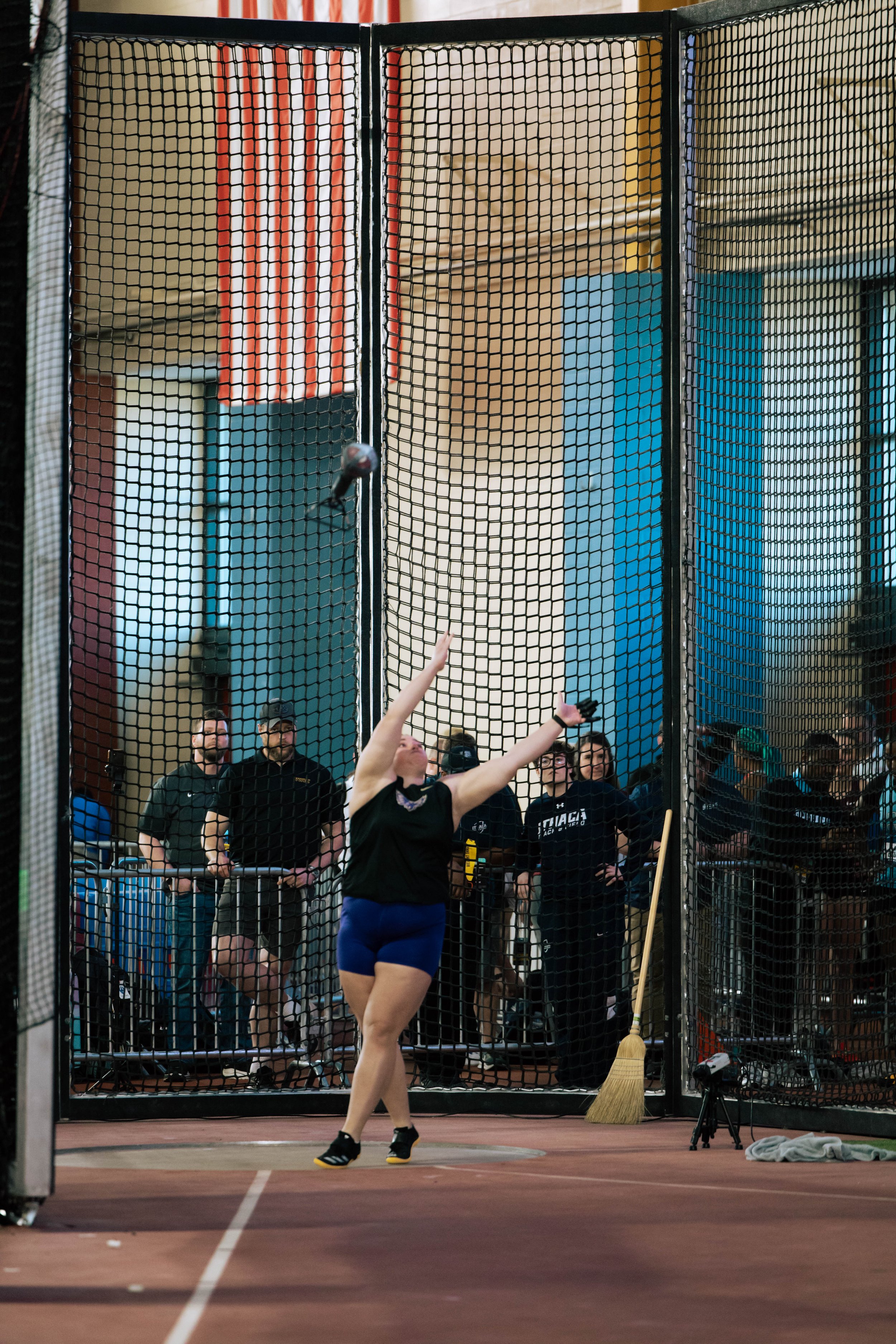
Photo by Jen Reagan
Calvin’s Sydney Radigan continued the excitement when she ran a speedy 23.71 in the 200m dash prelim to shatter UMass Boston’s Wadeline Jonathas’s 23.90-second national record set at the Crossplex eight years prior. Radigan previously held the third fastest time in history, which she ran on a flat track to qualify for nationals. In just her second race on a banked track, Radigan showed what she can do in optimal conditions, making her first ever national final in dominant style. She led Platteville’s Izzy Peterson to No. 2 all-time with her performance of 23.80 in the prelim.
WashU set the second national record of the weekend in the last event of the night, clocking 11:29.59 in the DMR, making them the first team to dip under 11:30. Their team of Lauren Raley, Kylie Spytek, Kalena Riemer, and Lucinda Laughlin charged to the front and held their lead from their 400-meter leg onward, with impressive splits for every leg: 3:30.51 for Raley, 55.75 for Spytek, 2:14.93 for Riemer, and 4:48.42 for Laughlin. With this performance, this quartet perfectly showcased why the WashU Bears have one of the best, if not the best, middle distance programs in D3 history.
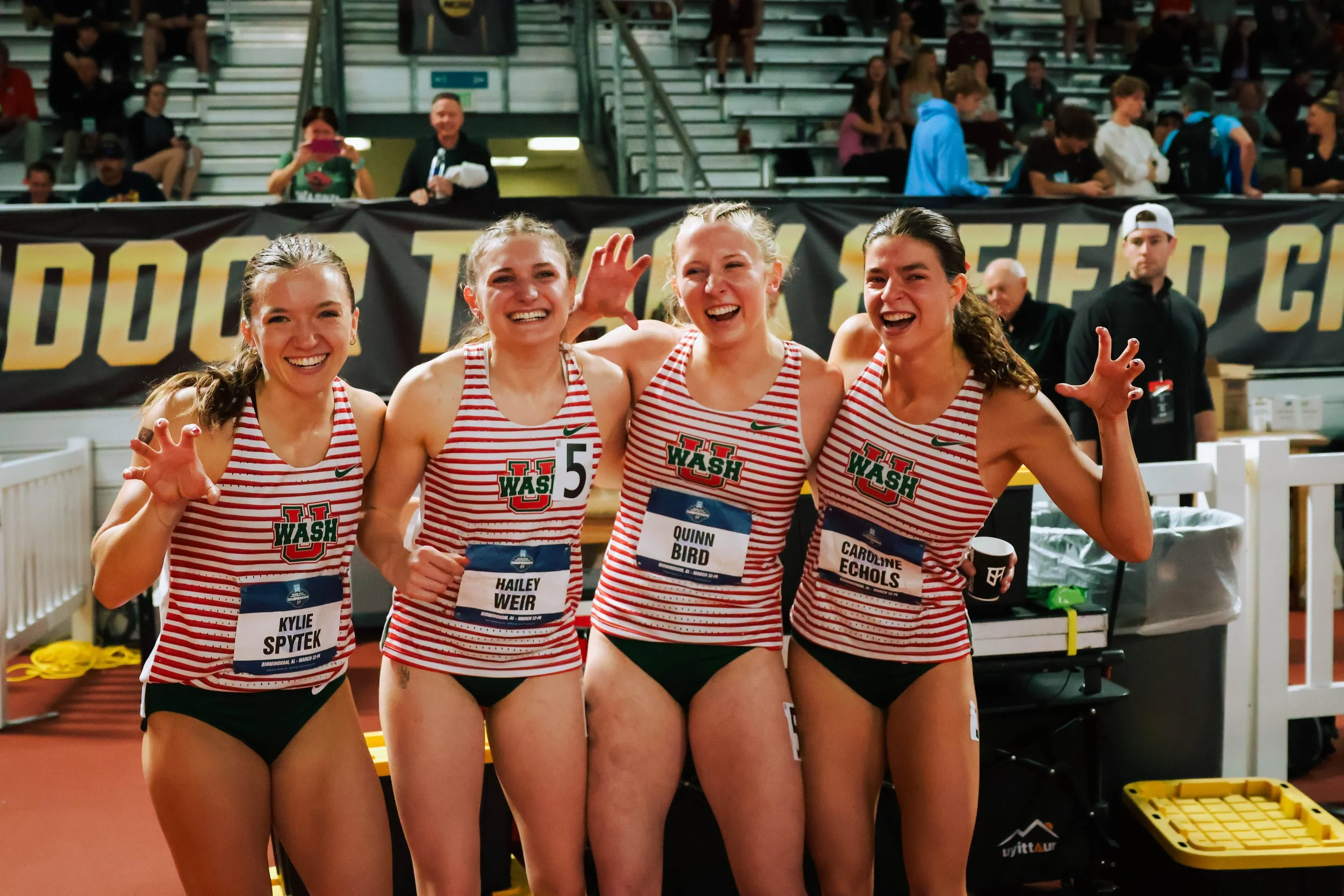
Photo by Jen Reagan
When fans were still sipping on their Saturday morning coffees, UMass Boston’s Aryianna Garceau charged toward the third D3 national record of the weekend in the first event of day two. Her 8.25 was the fastest 60-meter hurdle time of the season in the NEICAAA, a historical organization with members from all NCAA divisions across New England, and shattered her previous national record of 8.31 set at the New England D3 Championships earlier this season. With this performance, she became the first athlete in D3 history to dip under 8.3 in this event.
Just like they did on day one, the WashU Bears ended the day with a bang. Not only did they secure a national team trophy with their 4x400 relay, but they did so by setting a new NCAA D3 national record of 3:44.54. Only Wartburg has run faster when they ran 3:43.82 in 2012 on an oversized track, which the NCAA does not recognize as record-eligible, but D3GD does (sorry, WashU!) Still, the team of Kylie Spytek, Quinn Bird, Caroline Echols, and Hailey Weir ran incredibly toward the fastest record-eligible 4x4 time ever in D3, averaging 56-second splits to sweep the indoor relay events. Spytek, the relay warrior, emerged from the weekend with two relay national titles and two NCAA national records.
History books rewritten
An astonishing 70 top-20 all-time D3 marks were set over the weekend, making this year’s champs one of the deepest and most competitive in history. 41 of these marks were top-10 all-time marks. Once again, the women’s competition outshined the men’s with 41 top-20 updates to the men’s 29, and 24 top-10 updates to the men’s 17.
On both sides, the 200-meter dash saw the most change with five new or updated entries in the top 10 for both men and women. Rowan’s Rajahn Dixon set the leading time of the weekend when he won Saturday’s final in a blazing fast No. 2 all-time 20.92. The only athlete to ever have run faster was set by Rowan NJAC rival Ramapo’s Cheick Traore, who holds the D3 national record of 20.72. Oshkosh’s Dylan Doss narrowly missed the win from the second heat when he finished in 20.93, just a hundredth of a second off of Dixon, who led TCNJ’s Maxim Rychkov and Rowan teammate Eli Hendricks to No. 7 and No. 8 all-time performances, respectively. In the prelim, Salisbury’s Kai Smith ran a No. 6 all-time 21.09.
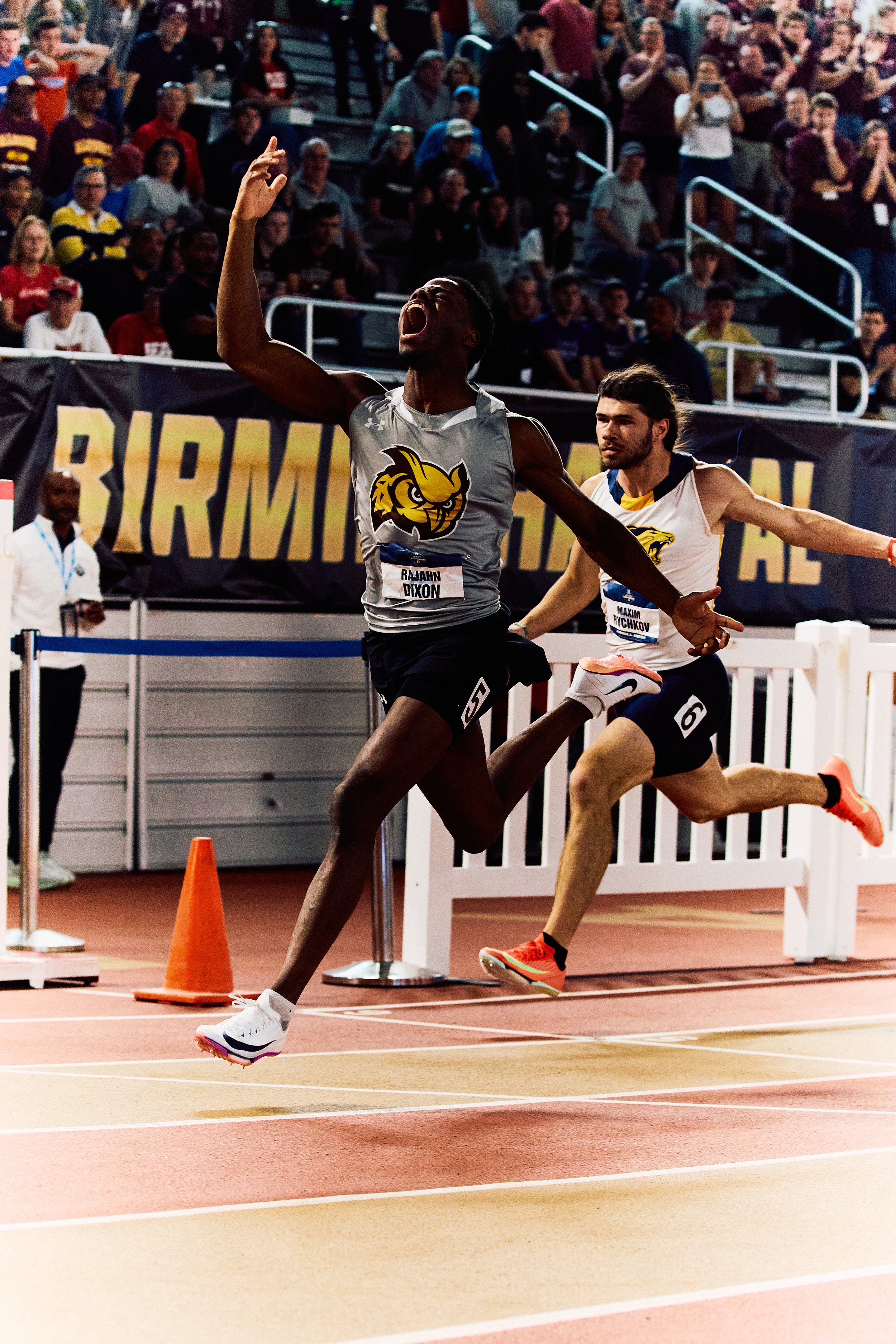
Photo by Alan Lam
In the women’s race, all five top-10 marks were set on Friday’s prelim when Radigan and Peterson dipped under the national record in heat one. JCU’s Dakota Houston soloed a No. 4 all-time 23.93 later in heat 4, and North Carolina Wesleyan’s Kamiyah Wooten and Hope’s Sara Schermerhorn battled to the line in heat five to land No. 6 all time for Wooten with her 24.14 and No. 10 all-time for Schermerhorn with her 24.23. Only Peterson bettered her prelim performance in the final, her 23.78 lowering her No. 2 all-time mark and earning her a first national title. She battled Radigan to the line, barely outleaning the Calvin star by 0.02 seconds. Wooten tied her PR at 24.14 to earn third in the final.
Other big-time updates and near-records in the D3 history books came from Macalester’s Ariella Rogahn-Press, who ran a No. 2 all-time 54.22 in the 400m dash prelim; UWL’s 4x400m relay, who ran a No. 2 all-time 3:10.90 to take down a legendary school record team from 2003 that included eventual Olympic gold medalist Andrew Rock; and River Falls’s Jacob Balcome, whose heptathlon score of 5487 is the second highest point total in D3 history behind 2022 national record setter Marcus Weaver. To help achieve this score, Balcome set new lifetime PBs in the 1k, high jump, and shot put, and nearly matched a PB in the 60m hurdles. His 2.04-meter clearance in the high jump would have placed him tenth in the open competition.
Freshman standouts
Thirteen first-team All-Americans over the weekend were freshmen, signaling a rising tide of new D3 talent. This group of rookies was led by WashU’s Kate Delia, whose breakout victory race in the women’s 800 earned WashU, the eventual team victors, ten points and their sixth 800-meter national title in program history. Delia ran even 400-meter splits of 63.79 and 63.9 to finish in 2:07.69, the second fastest indoor time in school history and eighth fastest time in D3 history. Typically, even splits in the 800-meter indicate a faster time is attainable, so we look forward to witnessing the new era of 800-meter talent coming out of Saint Louis.
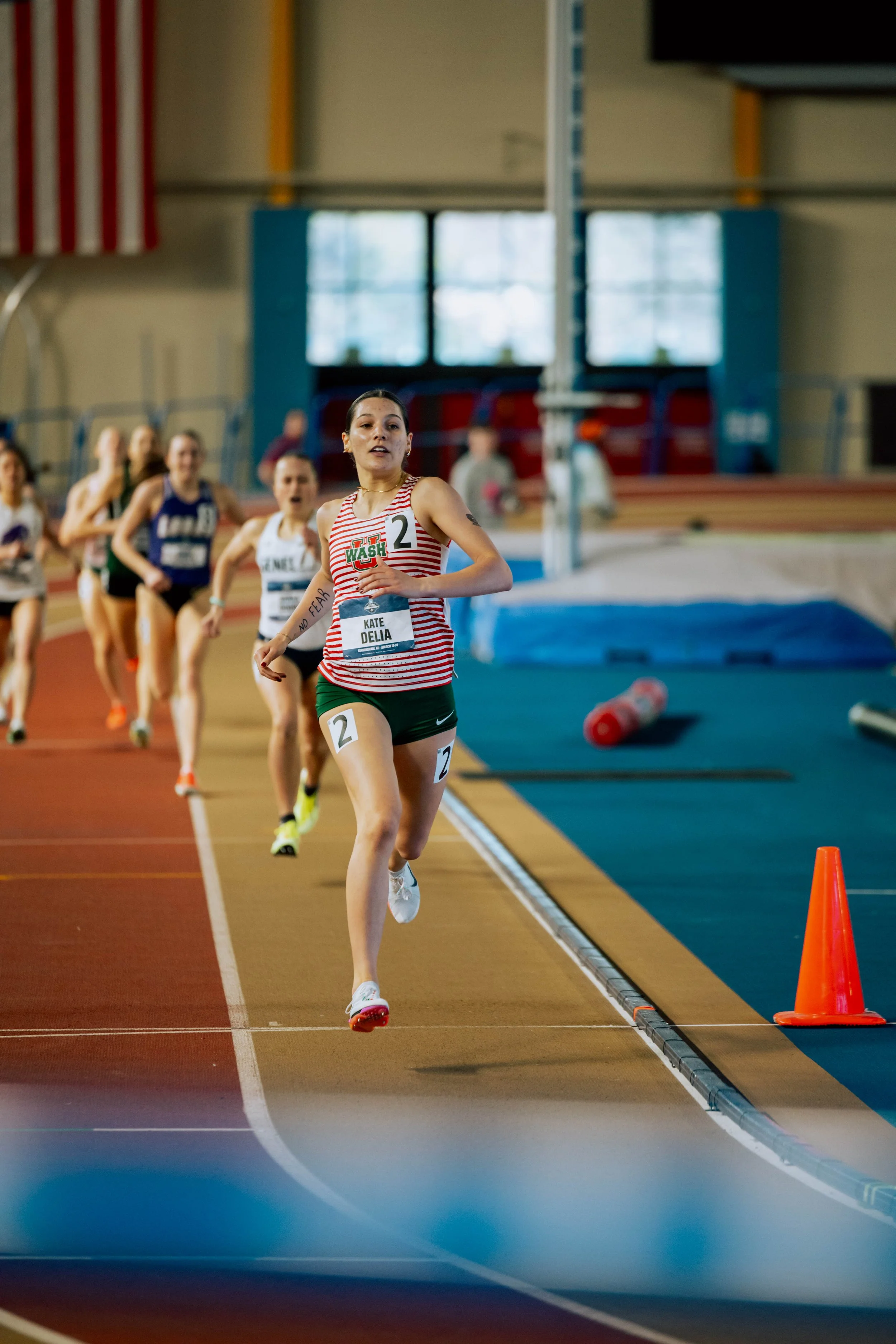
Photo by Jen Reagan
Distance events saw some freshman dominance with NYU’s Theo Udelson-Nee, who took third in the men’s 5k in an exhilarating last 400. Udelson-Nee was one of two freshmen to earn All-American in the 8,000-meter championship race in the fall. The top freshman in the fall was Johns Hopkins’s Anthony Clark, who joined Udelson-Nee on the podium with his impressive fourth-place 5k finish. Hopkins had two freshmen on the 5k podium this weekend, the first of which was eighth place finisher in the women’s 5k Mia Kotler, the 2025 14th place XC All-American and top freshman across both races in the fall.
The rest of these performances all took place in the jumping events, with the men’s long jump podium featuring the most freshman at three total. After Delia, Rowan’s David Brown tied with NYU’s Udelson-Nee for highest freshman finish with his third place finish in the men’s high jump.
Freshman All-Americans:
Kate Delia (WashU) 1st in W 800m
Theo Udelson-Nee (NYU) - 3rd in M 5k
Anthony Clark (Johns Hopkins) - 4th in M 5k
Mia Kotler (Johns Hopkins) - 8th in W 5k
Riley Gardner (Illinois College) - 8th in W HJ
Aubrey Rock (Westminster) - 8th in W PV
Lauren Murphy (Rochester) - 6th in W TJ
Brock DeBello (Wabash) - 6th in M 400m
David Brown (Rowan) - 3rd in M HJ
Bright John (Rowan) - 5th in M LJ
Uly Junker (Williams) - 6th in M LJ
Jason Ellman (Bethany) - 7th in M LJ*
Keenan Powell (Greenville) - third in M TJ*
*graduated in 2024, but do not appear to have competed collegiately yet
All you need is a chance
In an interview with D3 Glory Days on Thursday, Wittenberg’s Kory Davis said his goal was to make the men’s 60-meter hurdle final and finish top-8 despite his No. 13 seeding. Davis went on to accomplish just that, running a PR to secure the last qualifying spot in the final. He finished sixth overall, seven spots better than his seeding.
There were several other athletes who made big leaps from their seed to finishing positions, proving anything can happen at the national meet if only you are given the opportunity to compete. Sometimes getting to the national meet is the hardest part.
Williams’s Kate Swann had the biggest leap from her seed to her finish. Swann was the last athlete into the women’s 5k after three scratches. With a lightning surge in the final straightaway on Friday, Swann secured runner-up, a full 18 places better than her seed. Her last lap was a blazing 34 seconds, the fastest in the field by almost two seconds.
On the men’s side, Lamont Victoria made the biggest jump from seed to finish. He entered the meet seeded 17th, ran a massive 0.08-second PR in the prelim, and, in an astonishing finish that came down to the thousandth of a second, won the men’s 60-meter national title, finishing 16 spots better than his seeded position.
Victoria is one of four athletes who made massive leaps to earn a national title over the weekend. Calvin women had a dominant national meet, with Sophie Bull entering the meet 11th and coming away with the national title in the women’s 3k and Sydney Radigan capturing the women’s 60-meter title after entering the meet 10th. OWU’s Connor Smith came in tied for tenth in the high jump and won the whole dang thing.
Here are the biggest jumps (9+ spots) athletes made from unseeded to top-8 All-American:
18 spots: Kate Swann (Williams) No. 20 in W 5k to 2nd
16 spots: Lamont Victoria (Lynchburg) No. 17 in M 60m to 1st
14 spots: Uly Junker (Williams) No. 20 in M LJ to 6th
14 spots: Isaiah Watson (Hamline) No. 19 in M TJ to 5th
13 spots: Kate Tuttle (Williams) No. 15 in W 3k to 2nd
13 spots: Mackenzie Huber (Illinois Wesleyan) No. 17 in W 800m to 4th
13 spots: Eden Maranell (St. Norbert) No. 20th in W TJ to 7th
12 spots: Owen Clark (UWL) No. 15 in M 3k to 3rd
12 spots: Anna Sawicki (Lebanon Valley) No. 18 in Pent to 6th
11 spots: Evan Collette (Cortland State) No. 18 in M WT to 7th
11 spots: Cree Ross (Centre) No. 15 in M TJ to 4th
11 spots: Zoe Marcus (Amherst) No. 16 in W 800m to 5th
10 spots: Johns Hopkins No. 12 in W DMR to 2nd
10 spots: Elena Stanciu (UC Santa Cruz) No. 16 in W Mile to 6th
10 spots: Dylan Parker (Carthage) No. 18 in M 400m to 8th
10 spots: Sophie Bull (Calvin) No. 11 in W 3k to 1st
10 spots: Evan Lacey (RPI) No. 16 in M 3k to 6th
9 spots: Connor Smith (OWU) No. 10 in M HJ to 1st
9 spots: Jasmine Wright (WashU) No. 15 in W 60m to 6th
9 spots: Bailey Hedgemon (Washington & Lee) No. 14 in W WT to 5th
9 spots: Emerson Comer (SUNYG) No. 17 in M 5k to 8th
9 spots: Jordan Jones (Pfeiffer) No. 14 in M 60m to 5th
9 spots: Wartburg No. 12 in M DMR to 3rd
9 spots: Sydney Radigan (Calvin) No. 10 in W 60m to 1st
9 spots: Chris Short (Muhlenberg) No. 16 in M 400m to 7th
9 spots: Lucas Nicholson (Oshkosh) No. 15 in M 800m to 6th
9 spots: Evan Hofstetter (UC Santa Cruz) No. 15 in Hep to 6th
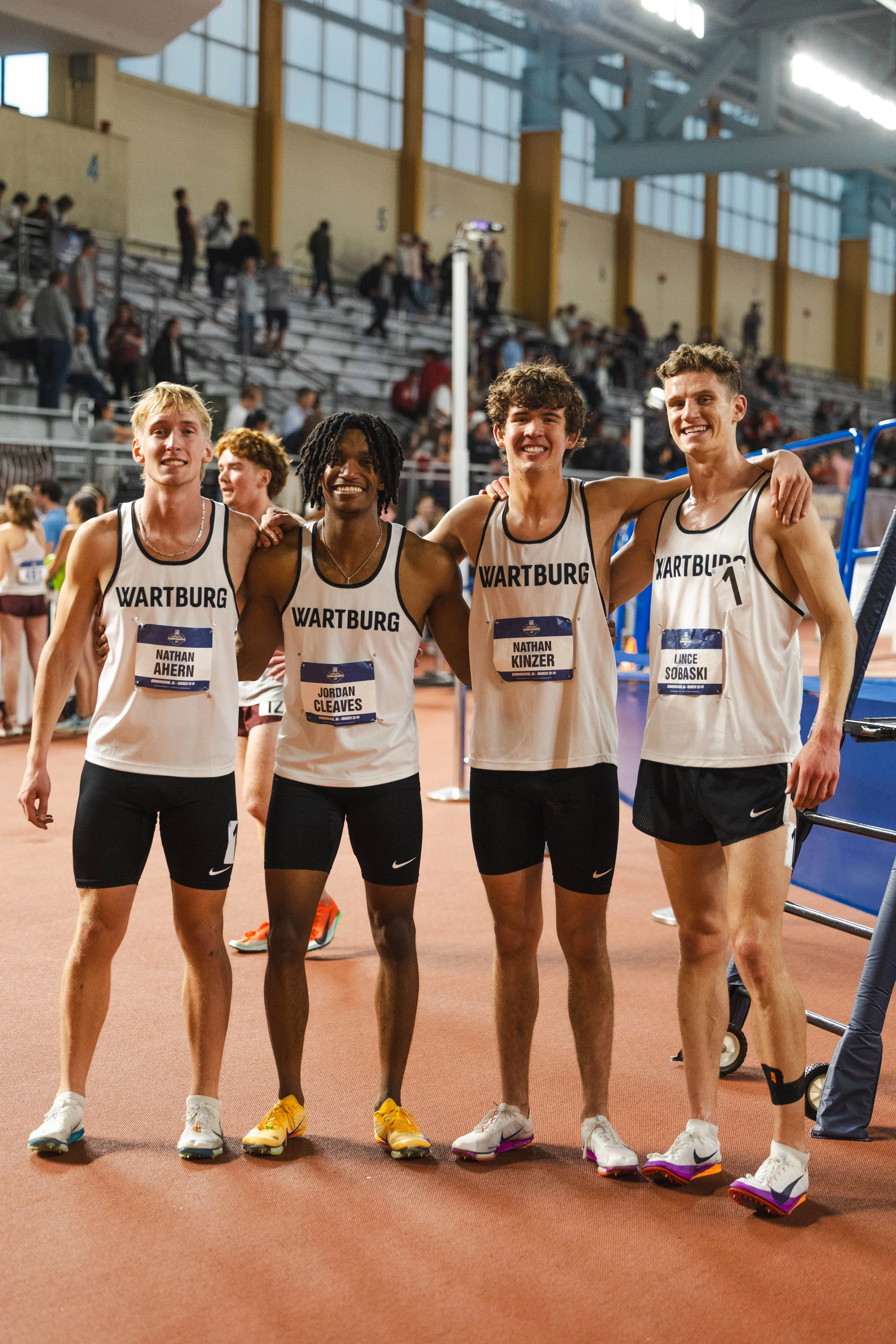
Photo by Jen Reagan
Here’s a special shoutout to Pfeiffer’s Jordan Jones and Wartburg men’s DMR team, both of whom not only far surpassed their seedings, but set top-10 all-time marks at the national meet. Jones’s 6.69 in the men’s 60-meter dash is No. 8 in D3 history, while Wartburg’s 9:45.77 is No. 7 all-time.
Boulderthon
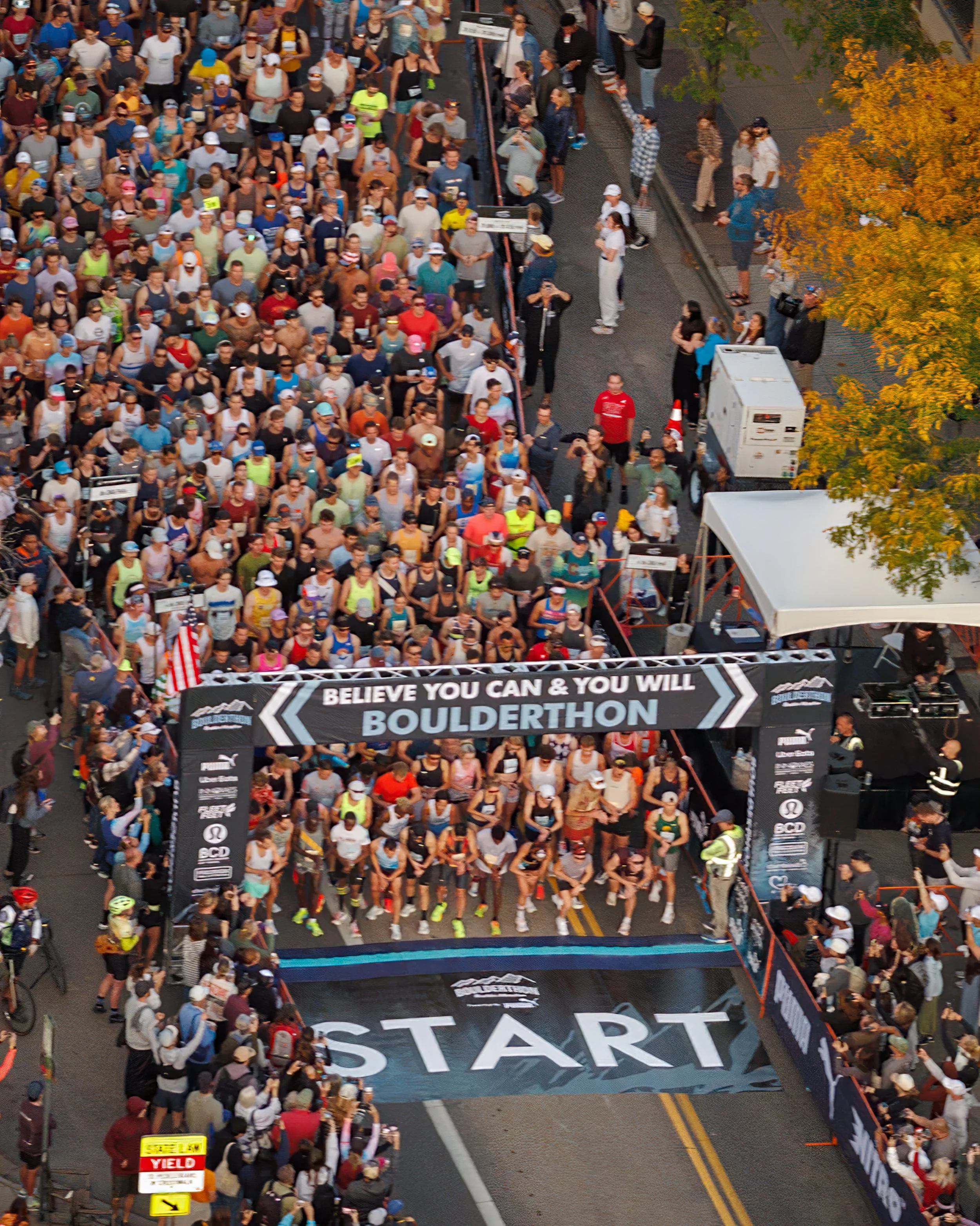
Are you looking for your next race? You hear Noah talk about how much he loves running in Boulder and now’s your chance to see why he loves it so much. Boulderthon is Boulder, CO’s signature downtown marathon series taking place on September 27, 2026!
Boulderthon has it all. From the 5k to the marathon, there is a race for everyone. Believe you can and you will!
Boulderthon is offering $20 off to our readers for the Half or Marathon. Use code D3GloryDays at checkout!
Podium takeovers
How many podium finishes does a program need to rename their university after that event? If the answer is 3, then Whitworth is Shot PutU, Rowan is High JumpU, and WashU is Pole VaultU. All three programs impressed in these events.
Rowan, who eventually won the men’s team title, scored big team points with their quartet of freshman David Brown, who took third, Jamile Gantt, who was fourth, Noah Wampole, who was sixth, and Arrington Rhym, who took eighth. Brown and Gantt both cleared 2.09 meters with Brown winning for being clean over his first four bars, and Wampole and Rhym both cleared 2.06 meters with Wampole being clean over three consecutive bars. They even had a fifth athlete in this event, Isaiah Davenport, who did not make it on the board.
In the women’s shot put, the trio of Whitworth Pirates Amblessed Okemgbo, Kylie Loveless, and Madison Carr took second, fourth, and fifth respectively to absolutely dominate the podium in this event. Okemgbo had a great meet, setting a new 14.37-meter personal best to take runner-up.
The WashU Bears made a sweeping statement in the men’s pole vault, capturing third through sixth place in a tight competition. Trio Peter Lichtenberger, Tommaso Maiocco, and George Bourdier all cleared 5.08 meters, while Hayden Kunkel cleared a new personal-best height of 5.03 meters to tie for sixth with fellow UAA vaulter William Floyd. Similarly to Rowan, WashU had five athletes in this event, with Zachary Duckworth finishing 13th.
Though not all wearing the same jersey, a trio of Kates took over the women’s 5k podium after Williams’s Swann took second, NYU’s Kate Cochran took third, and MIT’s Kate Sanderson took fifth. What was most eye-opening about the women’s 5k podium was how it directly reflected the D3’s best women’s cross country teams; NYU, Williams, and MIT each had a pair of athletes on the eight-person podium.
Fall team champions NYU featured Cochran, who didn’t race at XC nationals, and Josephine Dziedzic, who was fourth over the weekend and 11th in the fall, on the indoor podium. XC team runners up Williams saw fall All-Americans Swann and Tamar Byl repeat their All-American honors, and MIT awarded Sanderson and Rujuta Sane, the individual national champion, each their second trophy of the school year.
Spike drama
From false starts in the 10k to controversial lane line and impedance calls, D3 has seen its fair share of drama at the national championships. One of the unfortunate spectacles throughout the weekend was banned shoe disqualifications in the horizontal jumps events. A total of five athletes got disqualified across the men’s and women’s triple and long jump competitions, at least one in each event and two in the men’s triple jump. In each case, the disqualified athlete would have finished on the podium.
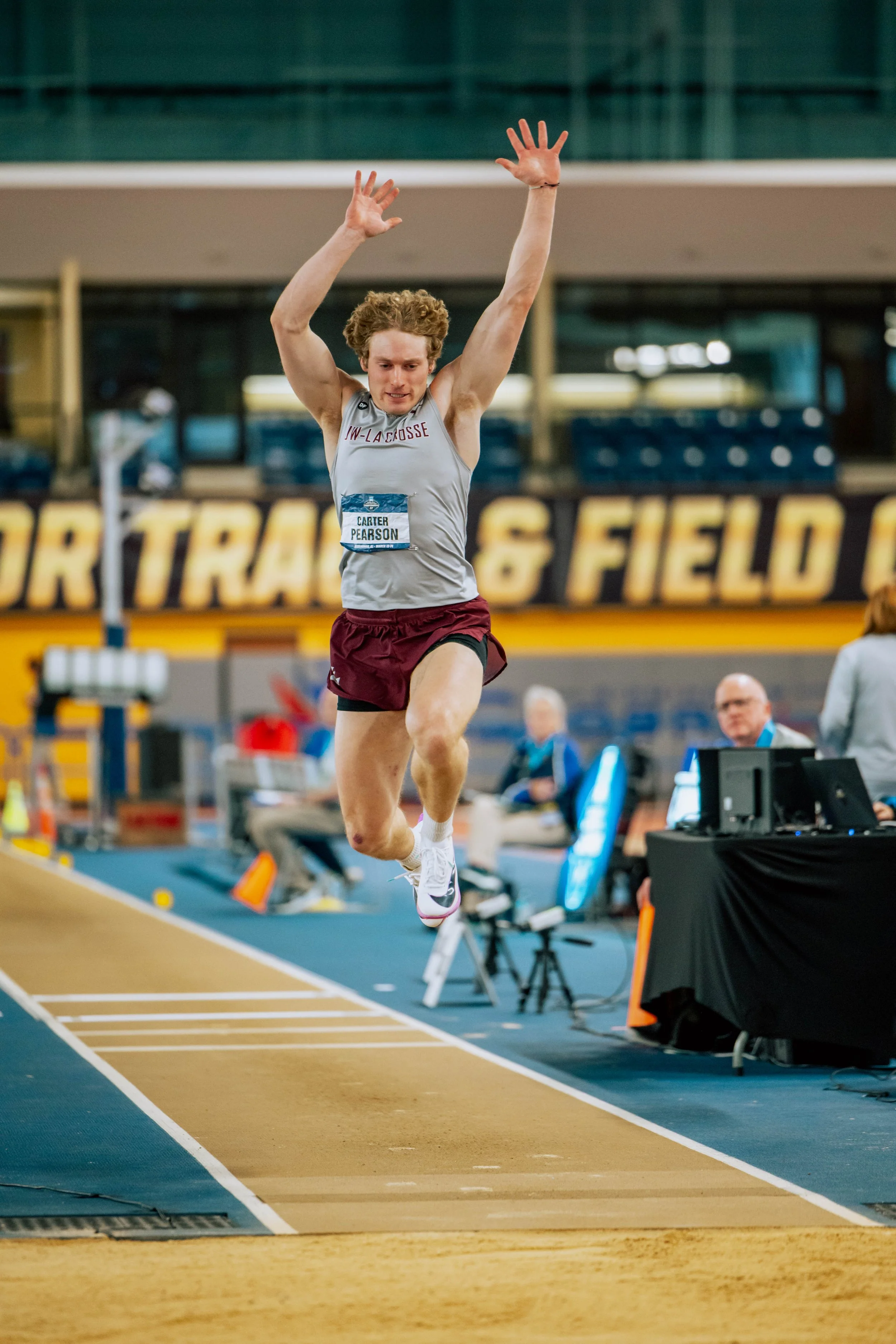
Photo by Jen Reagan
All athletes had to get their metal spike inserts checked before competition, but random participants were selected to have their whole shoe checked after competition. If an athlete was caught with banned spikes at the shoe check-in, or at any time during the competition by an official or protesting competitor, they were disqualified from the results. Two athletes were disqualified before their final even began.
So what’s the deal with banned spikes? Shoe controversy had been boiling in the track and field world ever since the pre-COVID release of “super shoes.” In 2020, World Athletics amended its rules to consider the advancement of shoe technology and published a list of approved athletic shoes.
This list features a table of different shoe brands and models approved in at least one discipline out of five: Track, Jump, Throw, Road, and Cross. If a shoe is on the list, it’s approved in any discipline with a green “Y.” If a shoe is not on the list, it’s not approved by World Athletics in any event. Some shoes, like the Nike Maxfly, a popular sprinting spike, are approved for track but not jumps.
Starting November 1, 2024, WA simplified the rules to prohibit any shoe exceeding 20mm in sole thickness (or stack height), whereas prior to this date, thickness up to 25mm was permitted. Thus, any shoe at nationals with a measured stack height above 20mm was grounds for disqualification. Popular Nike jump spikes like the Triple Jump Elite 2 have a stack height between 20-25mm and are therefore not approved by World Athletics since 2024.
What makes this rule somewhat confusing is that certain shoes can have one iteration of a model that is approved, and another iteration of that same model that is banned. Such is the case for the Nike Triple Jump Elite 2. Its predecessor, the Triple Jump Elite, and its successor, the Triple Jump Elite 3 are both approved. The second iteration, however, is not on the approved list.
In Division 3, most athletes are responsible for acquiring their own training shoes and spikes and might go all season competing in a spike they do not know is banned because of lack of rule enforcement. Thus, the national meet becomes a tough lesson.
Whether a lesson you’ve learned the hard way or one you hope you never have to, fans, coaches, athletes, teammates, this PSA is for you! Save this link to your browser. Check it before you buy those new spikes for outdoor season and double check it before the big dance. To the jumps athletes unfortunately impacted by these indoor disqualifications: go get that trophy in May.
Podium protest
Though we usually focus on the quantitative moments in D3 history – times, trophy counts, all-time marks, etc. – D3 witnessed a qualitative moment in history last week when the men’s distance podiums became stages for two separate podium protests. Both protests were seemingly directed at Rowan’s Seth Clevenger, a D1 Iowa State transfer who won both the men’s 5k and 3k handily – ultimately scoring the final points of Rowan’s national title score – and who has also been shrouded in an alleged doping controversy publicized by LetsRun.com in a March 2 publication of this year.
The allegations herein were convincing enough to prompt an organized podium step-off of the second through eighth place finishers in the day one men’s 5k awards ceremony. All of the athletes stepped off the podium upon Clevenger receiving his national title trophy and moved to the side to take a separate podium picture, one that excluded Clevenger.
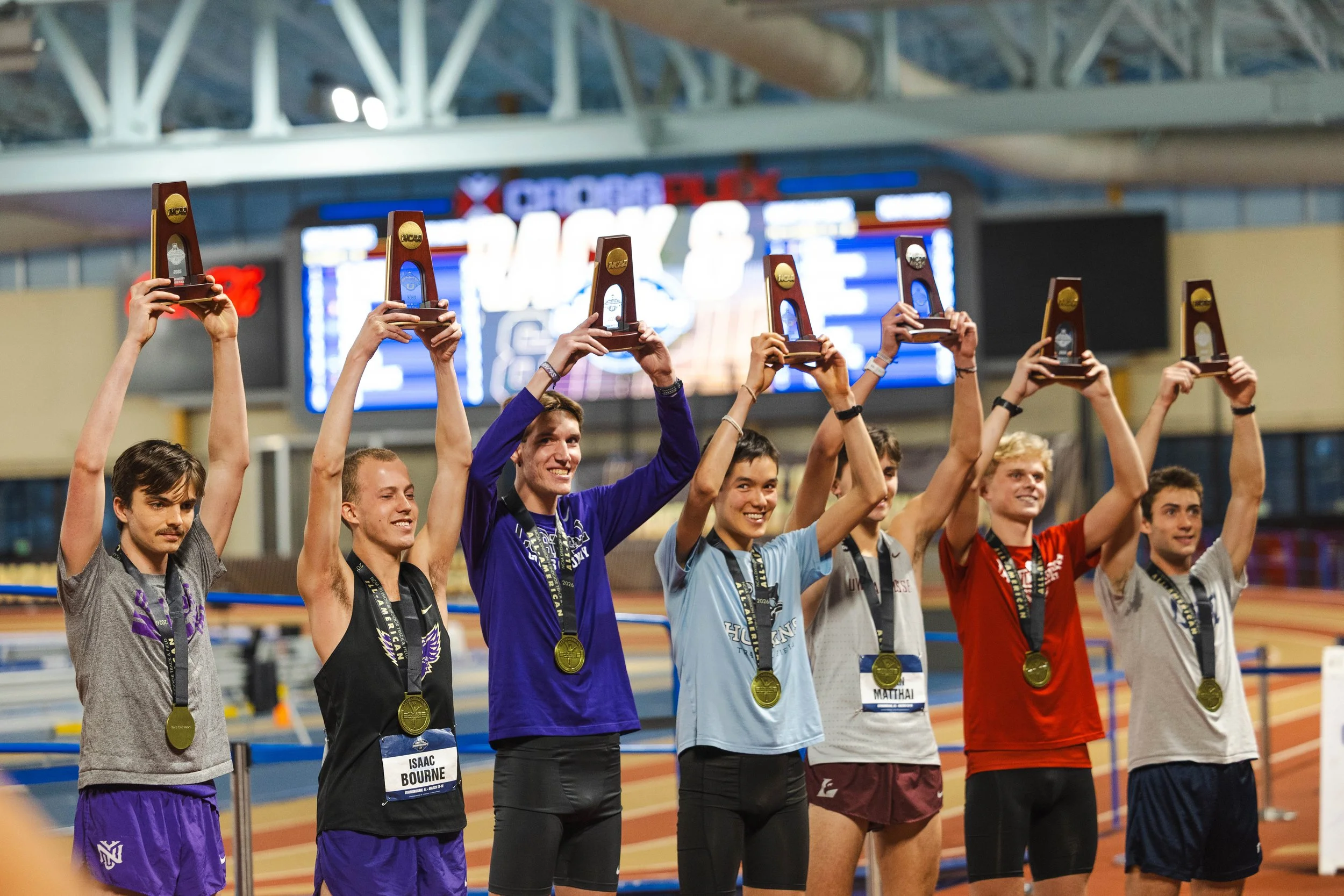
Photo by Jen Reagan
In our eyes, as the athletes stepped down from their podiums and filed off for an alternative group photo, they weren’t protesting Clevenger as much as they were protesting the systems that allowed him, or anyone with such allegations following them, to compete in the first place.
“For me, stepping off the podium was a no-brainer,” said one of the podium finishers. “It had been discussed among certain groups beforehand in the case that [Clevenger] won. It’s not about poor sportsmanship or being “salty” with losing, but rather, a desire for transparency from all organizations involved. We may never know the absolute truth, but until [Clevenger] is cleared of all wrongdoing from his previous team, people will continue to assume that he was kicked off for banned substances.”
Whether Clevenger is innocent or guilty, the fact remains: Cheating has always been, and will always be, a part of athletics. Positive tests are easily avoidable, if the tests happen at all. NCAA testing rules explicitly exclude D3, stating in its rulebook that “Student-athletes competing in Divisions I and II sports are subject to year-round testing.” Furthermore, NCAA athletics are becoming increasingly competitive – we see this in our own division with 70 new top-20 all-time marks from the weekend and even more so at the highest level of national competition – but testing frequency by the NCAA remains unknown.
At the 2025 USATF Outdoor Championships, 26% of competing athletes were NCAA athletes. This includes athletes running under NIL affiliations, which USADA Director of Intelligence and Investigations Dan Burke has publicly cited as something that is “heightening both pressure and temptation for athletes to seek performance advantages.” Of the NCAA athletes competing at outdoor USAs, only 16% were tested by USADA in 2025, leaving the remaining 84% untested specifically by USADA. Of the 2025 untested NCAA athletes, 26% made event finals or were top 10 in final-only events, and 11% had the world standard.
Surely athletes competing on the highest national level possible are also dominating their respective NCAA divisions, though clean sport integrity in the NCAA remains a question so long as testing transparency remains hidden and the countless number of member institutions – institutions with stakes like salaries, reputation, and national titles – are allowed agency in enforcing the rules. Burke went on to say of the NCAA’s anti-doping policies that “the need for reform has never been greater.”
Agencies like USADA exist because so often in sport, athletes are expected to compete against individuals under a cloud of suspicion, with little recourse to protect themselves. They go out, put allegations out of their mind, and square up against their competition on the level playing field they’ve created in their mind. Afterwards, they’re left with the questions.
On day two during the men’s 3k podium, a similar scene unfolded: all but one of the second through eighth place finishers stepped off the podium when Clevenger received his winning trophy from Rowan Assistant and Olympian Norm Tate. Once again, the participating group moved to the side for a separate photo.
“I made the decision to step off the podium before I even got to the national meet,” said another podium finisher. “Given the severity of the allegations against Clevenger and the Rowan program and the fact that they have declined numerous interview opportunities, there is no doubt in my mind that they have something to hide. That is not a good representation of what Division 3 is.”
*D3 Glory Days did ask Rowan coaches to interview Clevenger after the 5k and DMR and was declined both times.
The allegations will stay just that – allegations. Likely, no one will be able to prove wrongdoing, and the scenario where the allegations are completely false is just as hard to prove. What we’re left with is the understanding that no one made any effort to protect these athletes on either side. Obtaining the truth of this matter – whether clothed in innocence, guilt, or some combination thereof – is possible, but the associated institutions have indicated to the public that they are not interested in fully doing this work by choosing to remain silent. While a few outsiders may rush to judgement, shaking their head at a group of ‘sore losers,’ most understand that the podium athletes’ position was courageous. They ran their race and made their voices heard.
Hopefully someone will listen.
“Stepping off the podium in solidarity and taking a separate picture with the other All-Americans was a great moment with some of my best friends in the sport,” a podium finisher continued.
At the end of the day, “best friends in sport” is part of what makes D3 special, and it’s something that can perhaps only be fully understood by those who have completely immersed themselves in the division. It’s one that sticks together, celebrates each other, and asks “why not me?” in the face of every adversity.
This moment of protest in D3 is one that will be remembered for a long time because it reflected D3 athletes doing exactly what D3 does best: following their hearts.
Every athlete at this year’s championship made a commitment to do just that when they joined the D3 ranks, and here it gave us five national records, 41 top-10 all-time marks, 13 freshman All-Americans, four unseeded national champions, and three podium takeovers. Sure, there was drama, but more than that, there was passion, and that’s what deserves the most celebration.