Rose-Hulman men's cross country chases a new standard
Hey Everyone, Stu here. We’re sponsoring our own newsletter. Glory Days Track Club has been an idea we’ve been mulling over for a long time. We rolled out the Instagram in the winter, and had a few athletes run under our club name. Things got in the way, but now we’re back with merch for the club.
We’re rolling out two different hats: one running hat and one everyday snapback hat. More information about the club will be rolling out this fall, but who doesn’t love a good hat?
$36 for each hat, or $65 for both — discount applies automatically. Think of this as a way to support D3 Glory Days, and you get an awesome hat as a thank you.




On a wide, grassy runway beside the Little Blue River in Shelbyville, Ind., runners crowd between spray-painted lines beneath a hot, early-September sun. Most teams spill over two or three starting boxes. Rose-Hulman’s men’s cross country team fills five.
Seventy-four Engineers in matching bright red jerseys pack into five-foot-wide starting boxes on the Blue River Cross Country course. Thirty-four of them are freshmen. The starter calls the runners to the line. In sync, the Engineers crouch over one leg. The pistol fires, and they are off.
Breakthrough
“We're no longer hidden,” said Head Coach Derick Lawrence. “Making it to nationals last year was a big milestone for us. We were ranked eighth in the region and then shocked a lot of people to make it to nationals. I think in many cases we shocked each other.”
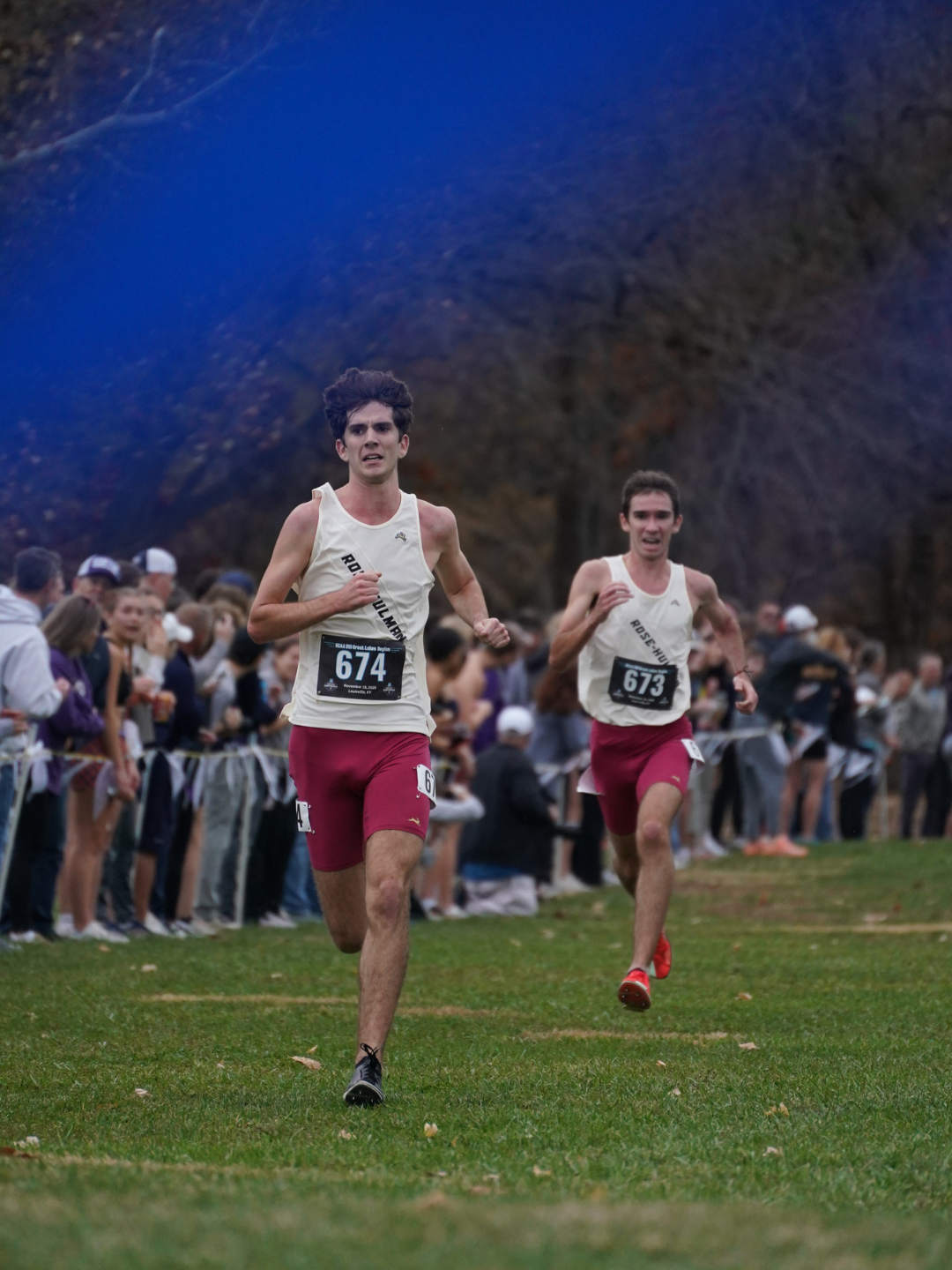
Photo by Peter Mcgowan
With a one-two punch from Sam Rinker and Joshua Pohle, the Engineers finished second at last year’s Great Lakes Regional Championship. On the following day, cross country’s version of “Selection Sunday,” they gathered in front of a TV screen and held a collective breath. Lawrence said they jumped for joy when they saw their names on screen, signaling an at-large team bid to the national meet for the first time since 2014 and the third time in school history. At nationals, they finished 29th, the second highest finish in program history.
This breakthrough had been building for four years. The team has improved its finish at the regional meet every year since Lawrence took the helm: 20th in 2022, 14th in 2023, 11th in 2024, and second in 2025. According to Lawrence, only two other Great Lakes programs in the last 25 years have gone from outside the top 10 one season to the top two the next.
Growth
Pohle has graduated and Rinker is spending the fall on a dream co-op in Tennessee. But the Engineers return the rest of last year’s national roster and add 34 freshmen—a class larger than the entire men’s roster at 40 out of the 43 teams in the Great Lakes region. Ohio Northern has the second largest total roster at 43, followed by Hope at 40, and finally Calvin at 34, which ties Rose-Hulman’s freshman class.
Lawrence explained that he didn’t put a number on his roster size in the recruiting process. In 2023, he brought 36 freshmen onto the men’s cross country team, which is still his largest incoming class to date. In Terre Haute, known as “Cross Country Town USA,” space is not an issue. The city is home to the historic LaVern Gibson Cross Country Championship course and Rose-Hulman’s campus. There’s plenty of room for a large team to train, ample opportunities to race, and no one is ever without a training partner.
Combine the location with U.S. News & World Report-ranked academics and a No. 26 nationally ranked cross country team, and the recruiting almost starts to do itself. Lawrence said that with such a large team, many athletes also spread the word to their high school friends, casting the recruiting net even wider.
“Once March and April were rolling around, [I started to see] it was gonna be a very big class,” Lawrence said. “So I rolled with it. Everybody has met our recruiting standards.”
Rose-Hulman publishes these standards. A recruit who runs 18:30 for 5k, 17:52 for three miles, 10:45 for 3200 meters, 5:05 for 1600 meters, or 2:12 for 800 meters by May 1 of his senior year has earned a spot.
Upperclassmen face standards of their own once the season starts, too. They are expected to hold and log at least 42 miles a week and to run at least 18:30 for 5k at the opener or 31:00 or faster for 8k at the second meet to be in the racing group. Those who don't can stay with the program in other roles, including as student managers. Lawrence admits the standards are unusual, but he said they keep the whole roster motivated.
The growth of Rose-Hulman’s roster comes as the NCAA landscape continues to change. Lawrence believes new D1 roster limits could create additional opportunities for D3 programs to attract athletes who might previously have pursued larger programs.
“Division 3 is bringing in a lot of very impressive individuals,” Lawrence said. “I think that there are Division 1 coaches that would love to have bigger roster sizes, but obviously they aren't able to do that. For us, it's just a matter of letting everybody know that, if you've met our recruiting standards, you have a spot here. If you want to be an engineer and you want to merge the two, you can here. I think a lot of Division 3 coaches are echoing that same message in their own way, and the [resulting] talent level [is] making everybody better.”
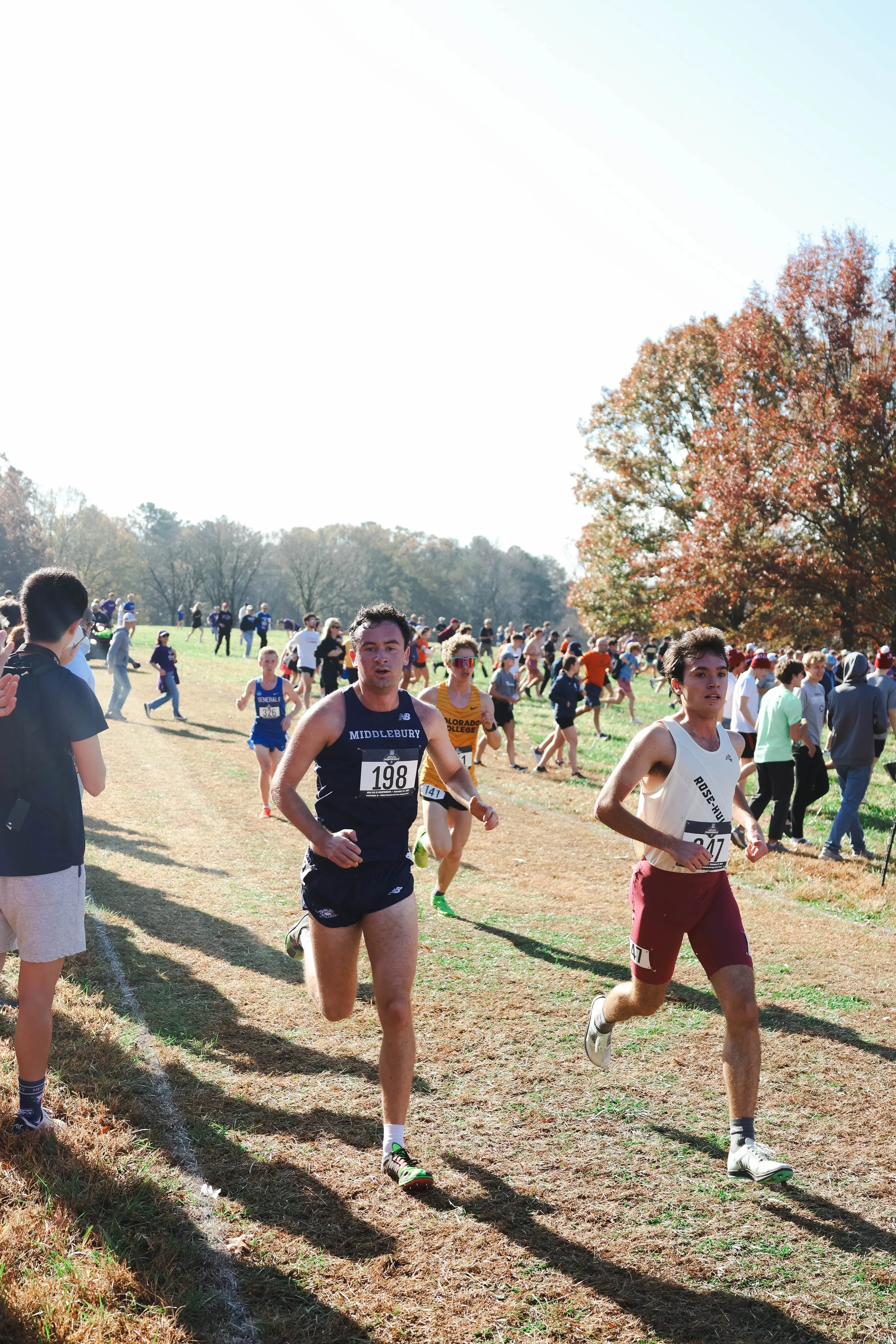
Photo by Jen Reagan
Lawrence said he recruits against lots of bigger schools like D1 program Purdue and D2 programs like Colorado School of Mines, Missouri S&T, and Michigan Tech. At a D3 school like Rose-Hulman, however, Lawrence can offer recruits something those programs cannot always guarantee: an opportunity to compete, develop, and find a role on the team.
“Guys that were maybe not given a chance to compete at other schools, [are] now finishing, first, second in the region, helping the team go to nationals, helping others realize that you can get to that point here,” Lawrence said.
Pohle is the athlete Lawrence refers to. With a high school personal best of 17:22, the now regional runner-up started his collegiate season with an 18:15 5k and 160th place at regionals his freshman year. He finished his Rose-Hulman career having placed 83rd at nationals and set school records in the 5k (14:42) and the 10k (30:34).
Management
74 men’s cross country athletes walk the campus in Terre Haute, wave to one another between classes, and descend upon the Union Cafe with appetites that threaten the profitability of an all-you-can-eat buffet.
“It's going to take the entire month of September to have all those individual one-on-one meetings,” Lawrence quipped.
The joke points to a more serious challenge: keeping 74 athletes connected to the program and its goals. To assist, Lawrence relies on a full staff and has appointed four captains with different roles: Will Boschen is lead captain, Rhys Phelps is performance captain, Chase Collins is development captain, and Jonathan Reid is operations captain. Collins is the only junior captain, but his role is especially important.
“He's a great bridge between the freshmen and the upperclassmen,” Lawrence said. “He's great about talking with everybody, getting to know everybody, making sure nobody's left behind, making sure that seventy-four individuals know that they are just as important as the number one individual.”
Individual meetings are another way Lawrence keeps a large roster personal.
“We have a lot of conversations, strategy sessions individually with everybody, helping them piece together [that] this is where we're at right now, this is where we can be,” Lawrence said.
Lawrence also uses a running analytics platform called Kailo, which was co-founded by Rose-Hulman graduate Tommy Mulc. The platform allows him to analyze his athletes’ training and racing data, manage rosters, and communicate about practice, pace groups, and workouts all in one place.
“That allows me to have more conversations with athletes, have more specific information that can lead to improvement, and navigate how different things like stress, sleep, and nutrition factor into their performance and confidence,” Lawrence said.
At an institution known for its academics, the demands on student-athletes extend beyond the course. Rose-Hulman is especially unique because the university runs on 10-week quarters, which positions finals week right between regionals and nationals, creating another challenge for Lawrence and his athletes to navigate.
Chase
A season debut win at the Franklin Grizzly Invitational provided data for a promising start. Varsity returners Rhys Phelps and Chris Lynn led the way with a second and third place finish, respectively, and freshman Grayson Rorick finished fifth to become Rose-Hulman’s third scorer. In the 5k off-distance race, the Engineers posted a 30-second spread from first to fifth, and scored 48 fewer points than the next NCAA D3 competitor, DePauw.
At John McNichols last weekend, the Engineers ran their first 8k of the season and finished well behind nationally ranked D3 competitors No. 14 WashU and No. 10 North Central in a large field dominated by D1 teams. Moving ahead, Rose-Hulman’s top 27 from McNichols will race Pre-Nationals in Northfield, Minnesota, on Oct. 3, on the course that hosts this year’s national meet. Everyone else will run the Nike XC Town Twilight meet on Oct. 2 at LaVern Gibson, the team’s home course.
“We know it's not gonna be easy to get back to nationals, and we just gotta put in a lot of work and be in control of what we're gonna do throughout the day to get back to that level,” Lawrence said. “The guys are all bought into that.”
Lawrence has his work cut out for him, too. Managing a roster of 74 is a challenge for him and his staff, but the size of the roster ultimately serves a larger goal: turning last year’s breakthrough into the beginning of a new standard for Rose-Hulman men’s cross country.
“Never in our school's history, on our men's cross country team, has a team that made it to nationals in the past come back the next year to make nationals,” Lawrence said.
“So we want to do something that has never been done before.”