Running for Fun and Personal Bests: Part III: A Fifty-Year Streak
Running for Fun and Personal Bests: Part III: A Fifty-Year Streak
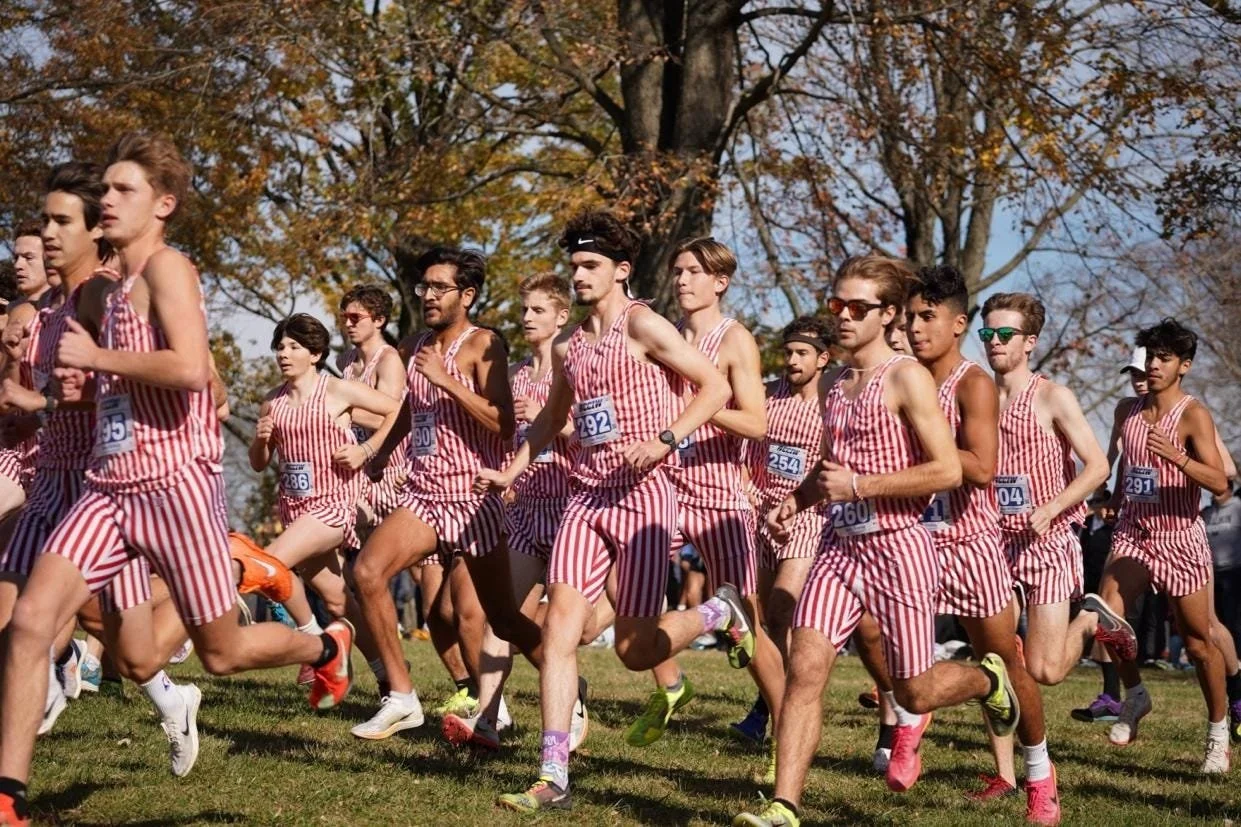
Title Photo by Noah Gabrys
“Here we are,” North Central head coach Matt Sinnott says to the runners in the huddle around him. “We’re in the championship season. All the work you have done has been to get us here.”
It is fifty degrees—balmy for November in Chicago—and the sky above is an endless blue. The trees at St. James Farm Forest Preserve are sighing off their last remaining leaves. And eight teams have gathered today for the College Conference of Illinois and Wisconsin (CCIW) cross country championship. The postseason has begun. Nationals is twenty-one days away.
“You have a great body of work,” Sinnott reminds his athletes as they stack their palms in the center. “Tap into that. Tap into your chemistry. Tap into The Stripes.”
They chant “1-2-3 TEAM!” and return to the starting line to strip off their sweats, revealing their candy-striped singlets underneath. North Central teams have worn these uniforms, these same uniforms, at every National Championship and every conference meet since 1968. Each one is pockmarked with flecks of mud and stains from rusted safety pins. The Stripes do not bear the name of any team, but everyone in D3 knows who wears them. The jerseys are iconic, but North Central couldn’t order new ones if they wanted to. The company that made The Stripes went out of business years ago. The oldest models, still in use, are coated in a finish that causes modern dryers to burst into flames.
Yet despite (or probably because of) their well-loved status, the athletes cherish The Stripes. “Earning Your Stripes” is a sacred honor at North Central, recognized with a special ceremony the week before Conference every year. “The Stripes are about something bigger than yourself,” the original designer, former head coach Al Carius, told the 2024 team at this year’s ceremony. “They’re bigger than I, I, I, bigger than me, me, me.” The Stripes are an “invisible bond,” he says, connecting the teams since 1968 to the team of 2024. And at CCIWs, that 2024 team plans to add another link in that chain.
The starting gun fires. Ten striped athletes leap off the line. Many of them know in the back of their mind that, if the next five miles don’t go the way they hope, this will be the last time they will wear The Stripes this year. The CCIW allows ten athletes to compete in the varsity race, but the NCAA allows only seven at Regionals and Nationals. The decision of which seven runners will represent North Central at those final two meets will largely depend on today’s outcome.
That winnowing looms over the runners as the field rushes down the starting field and dives into a thicket of dense trees. As the race begins, Patrick Gray, a finance professor at North Central who serves as the team’s academic mentor and a volunteer coach, offers the candy-striped athletes something else to think about instead. “Not everyone gets to be part of history,” he tells them. “Enjoy it.”
Indeed, history could be made today. If the men win the varsity race, North Central will have won fifty consecutive CCIW cross country titles in a row. It is the longest active conference championship streak in the NCAA. Today, the 2024 team hopes to bring it into its fifth decade.
Yet that streak almost snapped in the 2000s. After thirty years of consecutive CCIW conference victories, often by comfortable margins, in 2005, North Central scraped together a victory over Wheaton College by only two points. If North Central’s fifth man, Roland Hopkins, had run just five seconds slower, the conference streak would have died at thirty-years-old.
The hairsbreadth conference victory in 2005 marked the beginning of a desperate slide in North Central’s cross country performance during the 2000s—a slump that current athletes and coaches now call The Dark Years. Three weeks after nearly losing the conference streak, the team posted its worst performance at the National Championship meet since the founding of DIII: twelfth out of twenty-four teams. The next year, the Cardinals sunk to thirteenth. In 2007, they cratered to sixteenth. It remains the team’s worst performance at Nationals ever.
Although the cross country conference streak survived The Dark Years, in 2008 North Central lost to rival Augustana College on the track for the first time since 1985. To “lose a streak that’s lasted longer than you’ve been alive,” said John Lancaster, a sophomore at the time, “was devastating.”
Before 2000, North Central had finished worse than fourth only one time. Now, it seemed unclear if the coaches could right the ship. “Let’s take a moment of silence as the nation’s top program will falter for at least a decade,” wrote one poster on Letsrun.com. “Al Carius, thank you and it has been a pleasure.”
For those North Central alumni and coaches who watched the 2008 track conference streak snap, the start of the 2024 CCIW cross country championships offered a worrying flashback. As the field of seventy-five runners pops out from the woods half a mile into the race, Augustana’s Joe Langridge and Finbar Martin run shoulder to shoulder at the front. North Central’s top runners—Emerald Svienty, BJ Sorg, and Matt Jett—stalk behind them, close enough to reach out and touch but decidedly not in the lead. If the Cardinals want to take the streak to fifty, Augustana will make them work for it.
The Stripes are up for the challenge. After splitting the first mile in 4:39, Emerald, BJ, and Matt Jett seize the lead. The course turns onto a limestone path beneath a column of orange-leafed trees. The three pull ahead of Martin and Langridge. Then over the course of the next few miles, slowly, steadily, Emerald begins to break away from their teammates. As the 2K loops tick away, with the course diving again into the woods, then back on the limestone path, Emerald rolls alone at the front. They blast through the three-mile mark in 14:21. They have a nine-second lead over BJ and Matt Jett. And they are smiling.
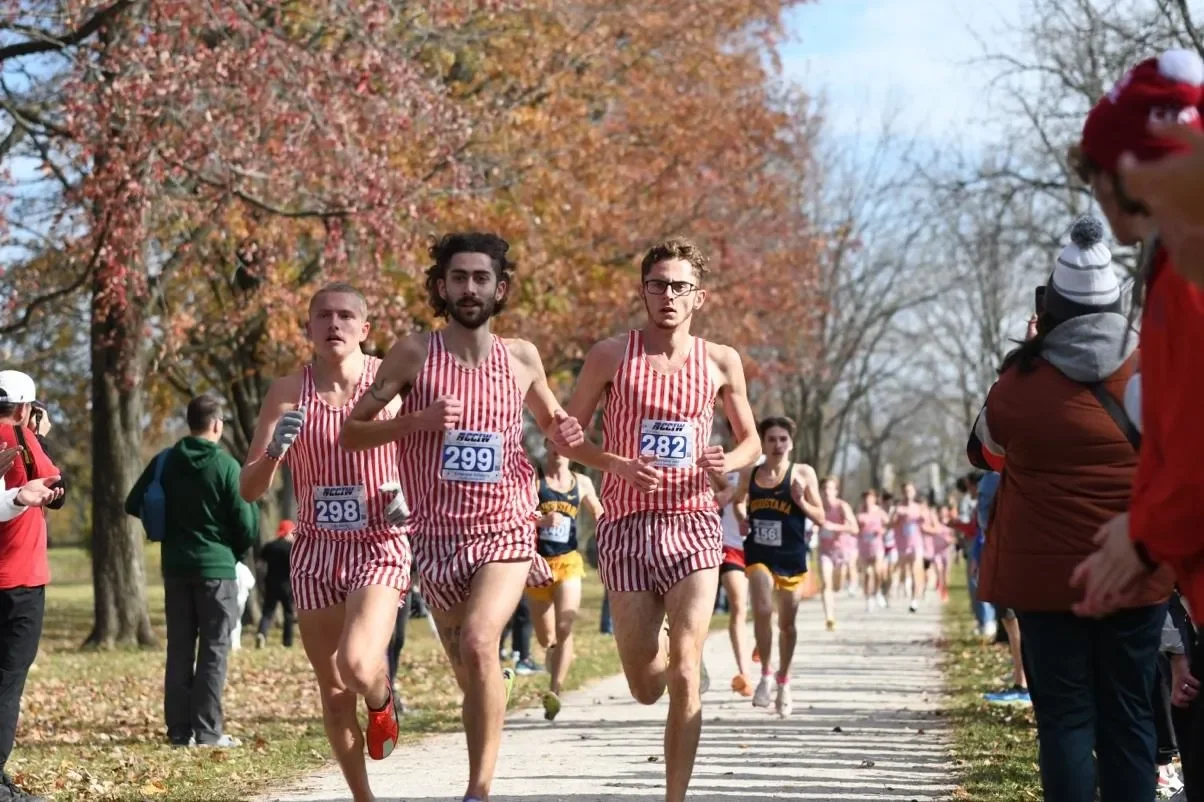
Left to Right: BJ, Emerald, and Matt Jett lead the race. Photo by Dominick Gramarosso.
Behind the top three, runners from Augustana continue to battle with The Stripes. Langridge and Martin sit in fourth and fifth place, and further back the Viking’s Grant Ackard leads a pack of three North Central runners. Fifth-year Johnny Olenek wants to change that. Johnny finesses alongside the Augustana runner, looks over at him, and surges. As if they had talked about it beforehand, fellow fifth-year Clark Kelly surges along with him. The team calls this “the North Central move,” a deliberate strategy to break an opponent by blinding them with The Stripes.
It works. Ackard falls back, and Johnny and Clark pump ahead. In less than a hundred meters, they build a gaping lead over the Blue and Yellow.
The supreme confidence on display—from Emerald smiling to the North Central move—is one of the secrets to North Central’s fifty-year streak. It is born out of hundreds of miles and a dozen hard slogs at Lincoln Park just this year. It is a form of absolute certainty that replaces hope. And it represents a core pillar in Al’s coaching philosophy. He named it The Knowing.
Al first coined the term in 1987, when the team found itself in a five-year title drought, it’s longest in the first fourteen years of D3. Before the national meet, Al drew a line on the floor of the campus gym. “I asked each member of the team to cross this line if they would like to win,” Al wrote in his memoir. Every member of the team did so. He asked them to cross back over if they thought they could win, then cross a third time if they believed they could win. But “believing was not enough,” he told them, “we must Know that we will run well enough to win.” He asked them to step over the line one final time if they knew they would win. They did cross the line. And they did win.
Twenty years later, when The Dark Years left the team in another dry spell, The Knowing became a core theme of their return to greatness. But that knowledge only comes through hard work. After the team’s national performances spluttered, ending in the sixteenth place embarrassment in 2007, Al made practice mandatory. He required athletes to complete the full workout at Lincoln Park on Monday and the weekly hill workout on Wednesday. And he insisted on timely reporting of weekly mileage.
Shockingly, North Central had won twelve national titles without these requirements. For Al, “the thought of making people run ran counter to my whole coaching philosophy!” But with these changes, he told his team, “We are going forward. What is most important is what we know and that we internalize the concepts, enjoy the process, and continue to grow to personal bests and a collective team best at next year’s National meet.”
Finally, during the 2008 cross country season, a year after a sixteenth place finish and only a few months after losing the conference streak in track, the team started to gain traction. They won the regular season Oshkosh Invitation. Then Regionals. “Wholeness and completeness must come from within,” Al wrote to the team afterwards. “All the characteristics have blended together into our ‘Knowing.’” A week later, North Central jumped fourteen spots from the year before to place second at the 2008 national championships. “That 2008 team saved our program,” Al exhaled in his memoir. “They ‘knew’ they would run well.”
The following year, they knew they would run even better. “I remember being more nervous coming to practice than I ever was going to a meet,” one athlete on the 2009 team recalled. After four months of pushing each other to their limit at Lincoln Park and Blackwell, “we had no doubt in our minds what was going to happen that year.”
What happened is that on a balmy day in Cleveland, Ohio, North Central won its first national championship in ten years. All seven runners won All-American honors, trouncing second-place Williams College 50-181. They broke the record for the largest margin of victory in DIII history. “They ran with their hearts,” Al said in a documentary later made about The Dark Years, appropriately called 16 2 1 and Beyond: The Fall and Rise of the North Central College Men’s Cross Country Team. “They ran for their teammates. They ran for their history. They ran with great character.”
The Knowing became a core component of North Central’s future success, as the team racked up six more titles in the next nine years. Since that most recent national championship in 2018, however, the cloud of another title drought has parked over Naperville. But at the 2024 CCIW championships, Sinnott sees a team that is once again running with The Knowing.
Emerald breaks the tape, alone and unchallenged, in 24:02, only eleven seconds shy of their personal best. Behind them, eight of the ten North Central runners in the varsity meet set personal records (PR). Johnny Olenek, the fifth-year who made the North Central move, continues his streak of PR’ing at every single major meet this season. Clark, who followed Johnny in that move, PRs by twenty-five seconds, breaking 25:00 for the first time and punching his ticket as one of the top seven for Regionals in two weeks.
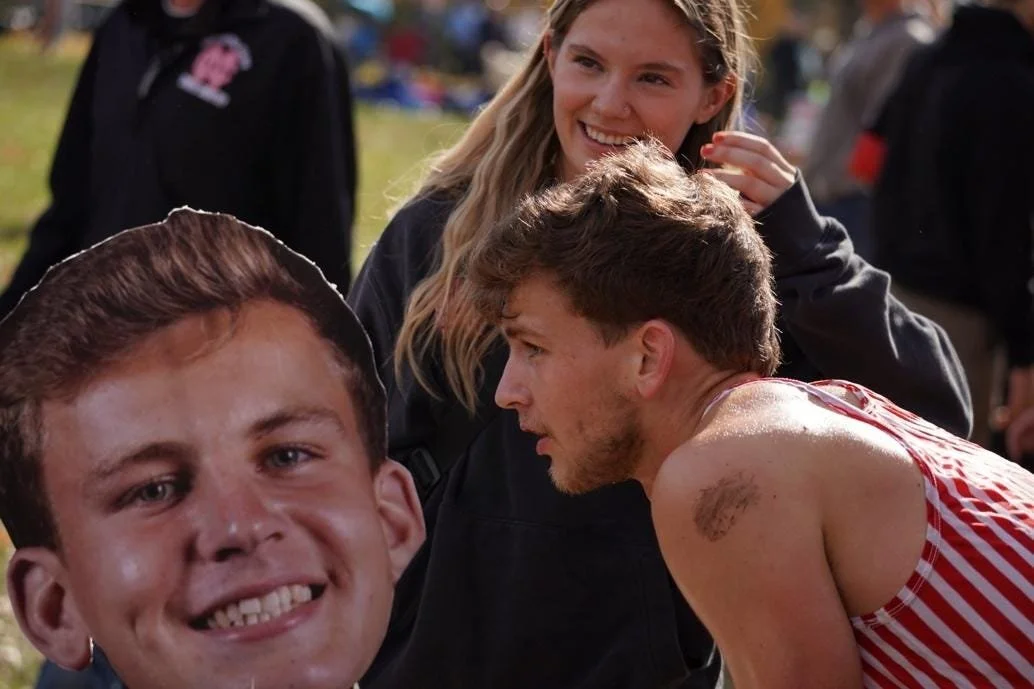
Clark Kelly after the race. Photo by Noah Gabrys.
Not only that, but in the subsequent open race, where athletes not on their team’s top ten have an opportunity to race, twenty-eight of North Central’s forty entrants clock personal bests. With these times, The Cardinals handily win both contests. They even perfect scored in the Open Race—and took the top thirteen spots to boot.
“You are all part of something historic!” Sinnott trumpets to the full team in a massive huddle after the awards ceremony. “We didn’t want that fifty-year streak hanging over you. We didn’t want it to be weighty. We wanted it to be something you can be a part of. Something bigger than yourself, something older than all of you. Older than me!” The team laughs. “Not older than Dale, though.”
The team laughs even harder. Dale Koepnick is the team much-beloved assistant coach, who ran for North Central himself starting in the 1970s. During his four years, the team won three national titles, with Dale serving as captain during the 1981 victory. And now, forty-three CCIW victories later, Dale clears his throat.
“Yeah, I just wanted to say.”
His voice is wavering. The laughter stops.
Dale has his arms draped around two of his athletes. He hangs between them, leaning forward. There are tears in his eyes. The weight of fifty years of cross country greatness—and of the national championship in only three weeks—hangs over all of them.
“I’m so proud of the men you are,” Dale chokes out at last. “And I’m so proud of the men you are becoming.”
Cam Mallett is an Assistant Professor of Sport Management at Mount St. Joseph University in Cincinnati, Ohio. He served as captain of his D3 cross country team at Berry College in Rome, Georgia before receiving his PhD from Penn State. He talks about running and sports history on his TikTok page, Footnotes With Cam.
Photos: Dominick Gramarosso is a Graduate Assistant for Men’s Cross Country and Track & Field at North Central College in Naperville, Illinois. A long time member of the program, his love for the program is embedded to his work as a photographer, a writer, and a coach. You can find his work on Instagram at domg.photos.