The Road to Berlin: The Nitty Gritty

Tailwind Nutrition is sponsoring this content. Whatever your training looks like turn to Tailwind to fuel you.
Complete Nutrition Made Simple - Tailwind offers easy-to-digest, all-in-one fueling, recovery, and hydration for endurance athletes.
Made for Athletes, by Athletes - Born out of real experience on the trails and refined with customer feedback.
Get 20% off your first order when you used code GloryDays20.
This monthly series follows the training of four D3 alumni, somewhere between sub-elite and elite, as they train to place within the top 25 at the Berlin Marathon on Sunday September 27: Lars Dewall, Elliot Kadrofske, Sam Forstner, and Christopher Brenk.
—-------------------------------------------
Name: Lars Dewall
School: College of St. Scholastica
Current Residence: San Diego, California
Current Affiliation: Lane Zero Athletics / Coach: Chad Salmela
PR: 2:12:30
Training is something that always seems straightforward in some sense, but it is constantly shifting and evolving as time goes on. Whether this means making personal tweaks or rolling with modern shifts and practices, I always think it’s important to understand the “why” of what you’re doing.
Going way back to my high school years I experienced decent success, but it wasn’t until my college years and working with my coach I began to lean on heart rate and lactate based training. In my early college years this was a really good gauge for me to measure in numbers if I was actually going to the correct intensity for that day. This is something that took me a long time to really implement correctly and get to work to my advantage. These principles I learned in college continue to drive the engine and methods of my training today.
Currently, things look different than they did in college in terms of my training mainly due to the fact that the marathon is simply a much longer race that relies essentially zero on the anaerobic system. Personally, I actually find it much easier to train for than any track events, despite the big training days. Each of my marathon blocks I’ve focused on attacking one weakness I feel that is holding me back. Being 25 and having many more years to come, I think this is an advantageous approach to training without changing too much. This block I have focused on implementing long run workouts with purpose vs easier long runs. In addition to this, I have made a much more deliberate focus to improve my nutrition when training, especially during these specific workouts. Each of my builds; excluding grandmas, I have increased my miles slightly. Going into CIM, I sat around 100-115. Boston more so 105-120. This time around going into Berlin, it looked more like 110-130. Although it’s a high load, having the summer off teaching has allowed me to absorb the uptick in miles efficiently so far. I am a very firm believer in keeping my easy days incredibly easy. I usually am following heart rate data and or lactate data to check in on this. This in turn, allows me to push on days that I actually need to push and get the best training adaptations. Keeping my easy runs truly easy has also allowed me to keep high volume consistency over long periods of time without overtraining and breaking down. I keep around 30-40% of my volume on a soft surface (tread or dirt) to decrease the overall mechanical load during the week during these big weeks.
Although this can require discipline when running with friends and teammates, I do my very best to make it work.
Although the team has people that have different things during the week, we do a good job of making things work. With people running different coaches, races and schedules; this also can get tricky to navigate, but it's nice to know that the team has each other's back even if we don’t get to meet and do the exact same thing every day. We really put in a good effort to do workouts together, so we can push each other and mimic race day practices.
The jumps I’ve made in running from college following my debut in 2025 at Grandma’s has been something I can confidently attribute to the training approach I have taken since I was 18 or 19. With the skiing background I always felt like I was suited for longer distances outside of the NCAA distances. Having the efficiency from years of high ski volume alongside my running has made the transition to full time running at high loads pretty manageable. With my coaches guidance together we’ve created a training plan that adopts what we’ve always done while refining weak points.
—--------------------------------------------
Name: Elliot Kadrofske
School: St. Olaf College, Class of 2020
Current Residence: Minneapolis, Minnesota
Current Affiliation: Collegeville Track Club / Self-Coached
PR: 2:21:46
I must admit my training isn’t the norm for most marathoners under 2:30. I embrace cross training in the form of stationary biking, and genuinely love what it injects into my training. The variety keeps running exciting, allows me to be the healthiest athlete I can, and has me enjoying the process to the max. Having two days where I just zone out, watch some TV, and spin at 20mph has my runs feeling fresh. The days of dreading a maintenance run are behind me and my legs feel all the more ready for the important workouts. Ever since dealing with repetitive hip issues for the last three years, I’ve taken a roughly five days running, two days biking approach. When the marathon cycle ramps up, I’ll throw in one or two biking/running doubles. Also in the midst of a 12-week cycle (my personal preference), I will take two non-consecutive weeks of all running, no biking, to really punish the legs and get some truly higher mileage on them. Somewhere up in the lower to mid-90s. And in regards to workouts for this upcoming cycle, I’m trying something new…at least to me, that is. I’ll still knock out one big marathon workout a week and/or a long run, but I also want to incorporate some more mile/5K paced stuff. I think acclimating my legs to faster speeds will work wonders on getting marathon pace (~5:16) feeling more manageable and relaxed.
Overall, a week for me looks roughly like:
MONDAY: medium-length bike @ ~19mph
TUESDAY - 5K/mile paced reps in the 30 second to 2 minute range
WEDNESDAY - Group run with Collegeville Track Club at maintenance effort
THURSDAY - Marathon paced workout with 7-9 miles total of race pace work
FRIDAY - long bike ride for the week @19-20mph
SATURDAY - Long run with Collegeville Track Club
SUNDAY - AM maintenance run, PM shorter bike @18-19mph
*Some weeks I’ll combine my Th workout with my Sat LR, making Th more maintenance miles
**Ten weeks out from race day last week had me finish with 61 miles of running & 3hrs of biking.
For the last three or four years, I’ve worked to create a healthier relationship with running. High school and college versions of myself were defined by being the last guy at practice and, in high school, consistently raking in the team’s end-of-season effort award. And while that level of dedication was indeed admirable, I can’t say my mental motivations were always the healthiest, especially in my collegiate and early post-collegiate days. Minutes and miles often became just that. Minutes and miles. No real purpose behind them and always needing a higher number to feel a greater sense of self worth. It didn’t help matters that higher miles were also paired with more calories burned, another number that constantly danced in my head. And while this ‘more is better’ philosophy worked alright for running solid times in college, my relationship with the sport was far from healthy. After an injury took me out from January-June 2021 (most likely due to excessive mileage and lack of stretching), I’ve slowly been working to retool and redevelop that relationship. During the time away, and especially as I dove back into running, I began to recognize that my all-in approach just didn’t create a healthy mentality, lifestyle, or body. I now want all my minutes to have meaning. I strive for smart training ahead of overtraining. And I treat food as fuel, not as reward. Those three things truly have been huge to both redeveloping my love for the sport and keeping my times on an upward trajectory. Meaningful minutes help minimize overtraining. Two days of biking creates some semblance of flexibility and improves the mental side of things, while keeping my weak hip flexors intact. And establishing a more holistic and less anal relationship with food has given my body the strength it needs to train at this high level under this new, flexible regiment. It’s been an incredibly rewarding redevelopment the last five years, and I couldn’t be happier with where it has gotten me.
—--------------------------------------------
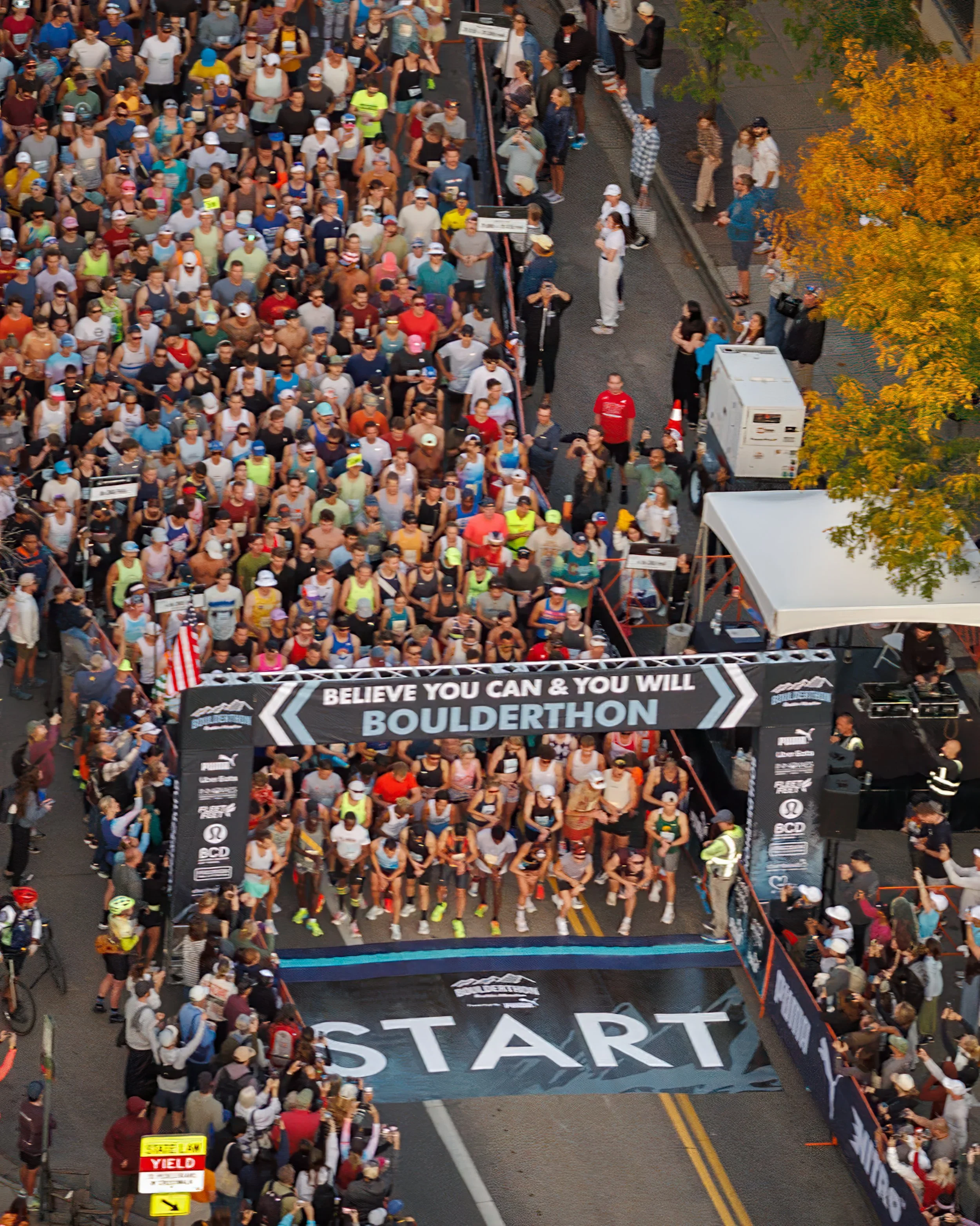
Are you looking for your next race? You hear Noah talk about how much he loves running in Boulder and now’s your chance to see why he loves it so much. is Boulder, CO’s signature downtown marathon series taking place on September 27, 2026!
Boulderthon has it all. From the 5k to the marathon, there is a race for everyone. Believe you can and you will!
Boulderthon is offering $20 off to our readers for the Half or Marathon. Use code D3GloryDays at checkout.
Name: Sam Forstner
School: Ripon College, Class of 2023
Current Residence: Stevens Point, Wisconsin
Current Affiliation: North Coast Running / Coach: Tyler Morey
PR: 2:16:58
Going all the way back to when I first started running, there never was a time when I could recall someone praising my speed or raw abilities. To this day, I still don’t know if I have a fast twitch fiber in my body, but I can vividly recall countless comments along the lines of “that kid sure has an engine” or “buddy just doesn’t quit, does he?” - The mentality of stacking blocks has been an area I’ve always taken great pride in, and in turn got me to a point where training became more fun than the racing itself at times.
In college, I never had a flashy training regiment by any means, but if there’s one thing I did, it was putting myself through the wringer every workout while constantly upping the mileage season after season. Every day had mileage set out to the tee, workouts had precise paces to hit, and a whole season was laid out on an excel sheet before a mile was ever ran. While the approach was brutally straightforward and somewhat militant, it is honestly a miracle I never injured myself, as I hardly learned to listen to my body. Certainly, there was still much to be desired. I hardly crosstrained, recovery protocol was simply to eat/sleep, and I actively avoided strength training as if it were a badge of honor. Let’s not forget college always had ample opportunities for “festivities” to take place. For actively getting an education, I must say it certainly wasn’t my brightest hour.
Fast forward to life after college, my mindset took a complete 180. The freedom of exploring my own routine left me with infinite possibilities of what I could dabble in. I began going to the gym, I started adding in deliberate crosstraining time, and I stumbled across the revolutionary idea of fueling during sessions. All of these factors gave me one of my biggest realizations - what if I valued total volume between all aspects of training, rather than just what the mileage chart says? For me, this was Pandora’s box. While I was able to rapidly get to my first 100 mile week, smash my first 20 mile long run, and do so while adding in the extra training facets, I frankly had no idea what the hell I was doing. Mash together starting a new job, adapting to a new town, and coaching myself simultaneously created a recipe brewing to implode. At my marathon debut, this mental fatigue showed, as every scenario that could’ve gone wrong due to a lack of planning showed up. I arrived the night before the race, barely made it to bib pickup, bought an industrial grade dinner from a discount grocery store (all traditional restaurants were booked), and called it a night in the steamy dorms. The morning of, I frantically rushed to the buses to get in the queue, only to realize my grave mistake once we already departed. I forgot all my gels. Upon a late arrival to the start area, the opportunity for a bathroom break was far gone, leaving me no choice but to hold the urge. I scrambled up the corral as far as I could, but clearly not far enough. Not 3 seconds after the gun went off amidst the crazed nature of the pack, I found myself staring down the starter marshall and proceeded to run us both into the pavement as if I was a brick shithouse linebacker. What does one do from there? Well of course, my mind ignored all rationality and said to immediately catch up to the lead pack, where I found myself running 10 seconds a mile faster than goal pace while dueling with the eventual women’s course record holder for a span of 15 miles. I’ll admit, going from being a nobody in college, to all of a sudden finding yourself mano-a-mano with an Olympian, all while being broadcasted by the courtesy vehicle as the lead woman - it was quite the surreal transition. That endorphin high lasted for a good 90 minutes, until the realization set in that I was completely tapped, no gels in hand, and there was still 10 miles to go. Maybe full sending wasn’t a great idea. As they say, misery loves company, and a cold sweeping downpour began by this time of the race to solidify the pending atmosphere. By the graces of David Goggins “Can’t hurt me” blaring through my mind, the reminder that I was only 40% exhausted kept my worst mile above a 5:50 pace miraculously. That remaining 55 minutes was the most grueling pain I had ever endured, but I have carried it with me to this day as a reminder that it can ALWAYS be worse.
After the race, the opportunity to be coached under Tyler Morey at North Coast Running presented itself, and I jumped on it without hesitation. For my upcoming races, I now had a new layer of accountability and the mental burden of planning everything taken off my plate. The approach of “effort based training” was a novel concept to me at the time, but I am beyond grateful it crossed my path. The core philosophy of learning to listen to the body, but not being afraid to keep adding volume became an extremely fun yet challenging balancing act. As a result, I invested heavily into the areas I knew I was lacking. I bought a road bike, I doubled down on fueling practice, but most importantly learned how to decompress and mentally unload after stacking days. By repeating this cycle, I had an unbelievable realization that I had doubled my average weekly training volume in a matter of 18 months. By allowing myself to pull back the reigns when needed, but pivoting in a way that still allowed me to put in work for the day, I had gone from 13 hours of training a week in college to weeks upwards of 25-30 hours. It truly became a snowball effect where the more I did, the hungrier I became to get back out there. Within the past year, I’ve had 5 hour+ training days, 27 mile long runs, 150 mile training weeks, countless grueling heat training sessions, all simply for the love of the game in the sake of self improvement.
In the current moment, this process has now become more about refining the time I do have available to me. I recently transitioned from an hourly worker to salaried, meaning I have less of a consistent work routine and overall time in the day to train. This new lifestyle certainly has challenged me in more ways than I would’ve imagined, but it is a constant reminder to stay curious, think big picture, and most importantly - to love the grind.
—--------------------------------------------
Name: Christopher Brenk
School: St. Olaf College, Class of 2020
Current Residence: Laramie, Wyoming
Current Affiliation: Unaffiliated / Self-Coached
PR: 2:17:34
My training is more or less the amalgamation of my favorite training philosophies from each of my past major coaches. It can be challenging to train here; the high plains are tempestuous. My hair blows constantly so I always wear a hat and the peak UV is 11 on a sunny day which there are 300 of in the year, and a thunderstorm conjures out of positively nothing which turns an easy run into an all-out sprint back to the car, and the lungs always feel wretched at 7,200 feet and higher, and it’s just me out there. You see the point. My “self-coaching” is imagining dialogues with my old coaches when I’m planning and thinking things through. It is not challenging to imagine what they’d say:
-From my high school coaches Coach Lawrence, Westphal, Kupres, and Snee, I gravitate towards simplistic workouts like mile repeats, Ks, and timed hills. I still frequently do their general strength routine they taught me in 2012. And whenever my mind starts with excuses during a solo track workout, I can still see Coach Lawrence bellowing on the sidelines at an intensity which I have never experienced since, and likely will never again. I am continually thankful for the level of care and commitment they exuded to all of us.
-From Phil Lundin, my first college coach, I constantly apply his wonderful mentality that all of this is really not that important in the grand scheme of things, and anything can be changed or tweaked. There was not a single time when I would come up to Phil and ask what if I did Y instead of the prescribed X for the day, and he wouldn’t clap and say, “Let’s do it!” Phil would speak fewer words regarding the workout prescribed for us that day, and more on what he was excited to cook for dinner afterward. “Boys: let’s get the job done, and go home!”
-From Brian Power, my second college coach, I will never forget how kind and accommodating he was when I learned about my health condition, and how important it is to pick your battles. Easy days, it turns out, can be very easy, and I ran a whole lot of them that winter. On several occasions he verbally forbade us running under a certain pace on easy days, and I grew to more tangibly see from him the value of the recovery day in its purpose, towards a better subsequent workout.
-From Paul Vandersteen of Coach Steen Running, I prioritize a higher frequency of longer efforts and stronger long runs. I have fully implemented his signature mid-week MLR (medium long run) and occasional barn-burner long run-workout, which have drastically increased my aerobic capacity and confidence as a result.
I don’t run as much volume as I perhaps should, and my builds keep shortening. (Twin Cities 2024 I averaged 74 miles over 12 weeks and ran 2:22. Chicago 2025 I averaged 77 miles over 11 weeks and ran 2:19. Eugene 2026 I averaged 81 miles over 10 weeks and ran 2:17.) But certain factors work to my benefit. The first is being in Laramie itself, which hardens the resolve and constantly works its high altitude magic. The second is the elevation gain I run: I have aimed the past few years for approximately 200,000 feet of gain in a calendar year. (the bulk of that being outside the actual marathon training blocks themselves.) This has made my legs much stronger, forced me to slow down on easy days, and above all made any given run a lot more breathtaking, serene, and something to look forward to.
The final and most challenging component for me has been figuring out fueling: not during running itself but purely outside of it. A symptom of the disease I have is at any given time there are approximately a dozen razorlike ulcers in my stomach that were described as looking “like bear claws on a tree.” For a long time I thought it was normal to feel nauseous both while running, and after eating any large (frankly normal) quantity. With a set 3:15 practice in both high school and college, I didn’t eat nearly as much beforehand as I should have before out of fear of that pain, and so for the first 8 years of running I showed up chronically underfueled and causationally injured. Just like that, upon graduating in 2020 and establishing my own running schedule, I was able to eat more adequately and wait out that pain as long as necessary, and I haven’t had a serious injury since. It has been thrilling, at times, to see my progression after the recognition of this pattern so clearly in the sand for many years. But that doesn’t mean I wish I could change anything: if I “figured it out” in high school I would’ve likely aspired to go to a D1 school versus D3; and then my running would’ve been attached to my financials, and like more D1 runners than D3 (purely anecdotally speaking) I would’ve probably cast running aside as a product of the times to idly reminisce on today instead of something to continually do for fun, for personal bests, and for community.
—--------------------------------------------
The Berlin Marathon is 8 weeks away. Lars, Elliot, Sam, and Christopher were all recently accepted into Puma’s PROJECT 3 for Berlin, supporting us with nutritionists, sports psychologists, camaraderie with other PROJECT 3 athletes, and an imposing amount of gear. Thank you to PROJECT 3!