Building For the Fall: 2025 Finale
A tectonic culture shift is happening in competitive marathoning. An OTQ (Olympic Trials Qualifier) used to be the inordinate domain of professionals and D1 talents - and once in a blue moon a long haired, mustachioed, Boulder-relocated D3 prodigy might come along. D3 has always been “for the love of the game.” Yet the game ended after 4 years.
A big thanks to Bombas for their support this fall. Get yourself some good socks. Trust us they make all the difference. Use code GloryDays21 for 21% when you checkout on Bombas.com
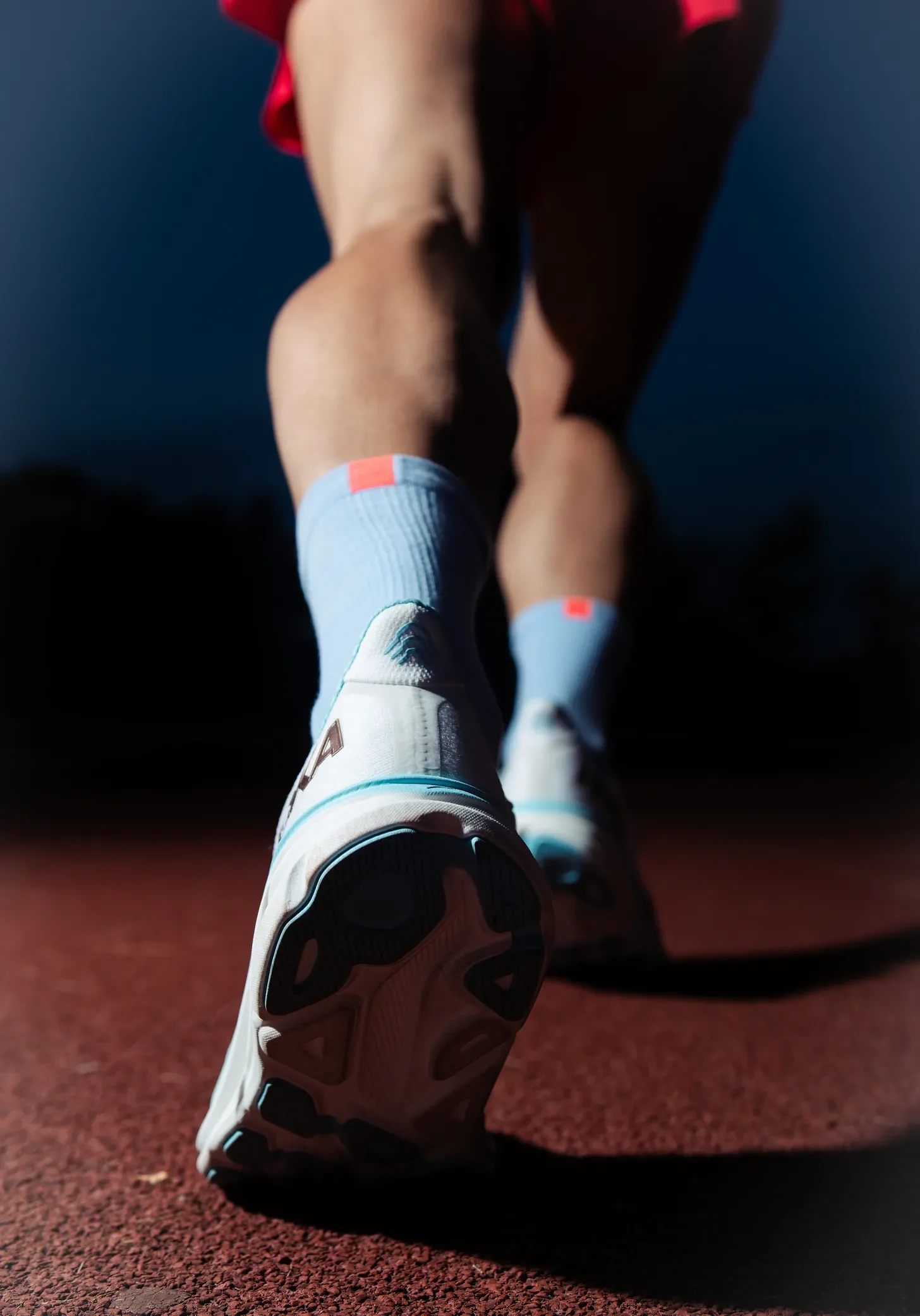
Then the sport advanced. Shoe tech offered various percentage boosts at exorbitant price tags. Training knowledge leaked into the ubiquity of the internet. NIL money has begun to push more D1 hopefuls to D3. Covid indiscriminantly drove the population stir-crazy. When the 2024 Olympic Trials came around, 45 D3 runners (28 men, 17 women) had OTQed over the span of the 2.5 year qualifying window. That was a remarkable number for almost exclusively unsponsored athletes. You’d think the statistics would plateau, and yet across all metrics of the sport, anything but appears to be happening. Latent potential is blooming across the country like flowers after a frost.
3 months into the 2.5-year qualifying window for 2028, 18 D3 women and 9 D3 men have already OTQed. I can garner almost no consistency to the “how” of each of them doing this, other than the fact that their lives look awfully busy and that they made it happen still. New parents, grad students, front-line healthcare workers, corporate ladder climbers. High mileage-low intensity, low mileage-high intensity, and even the twisted specimen that still crosstrains. Those with a robust post-collegiate team, and those who run every mile alone. Every case is here.
D3 OTQs as of 12/10/25:
Women:
Gabi Rooker - 2:26 at Chicago (UW-La Crosse 2010)
Maya Weigel - 2:28 at CIM (Pomona-Pitzer 2017)
Amanda Mosborg - 2:32 at Indy (Carleton 2021)
Sara Passani - 2:34 at CIM (CMS 2016)
Alyssa McElheny - 2:34 at Indy (Calvin 2015)
Clara Mayfield - 2:34 at CIM (Carleton 2023)
Rachel Hyland - 2:35 at CIM & Chicago (Williams 2009)
Anna Kenig-Ziesler - 2:35 at Chicago (UChicago 2023)
Macy McRowe - 2:36 at Indy (Muskingum 2023)
Piper Atnip - 2:36 at Indy (Edgewood 2019)
Abigail Morro - 2:36 at CIM (Scranton 2021)
Stephanie Rouse - 2:36 at CIM (Grinnell 2013)
Izzi Gengaro - 2:36 at CIM (MIT 2022)
Alosha Southern - 2:36 at CIM (Grinnell 2017)
Bridget Blum - 2:36 at CIM (CMS 2016)
Sarah Czuprynski - 2:36 at CIM (NYU 2015)
Diane Neubauer - 2:36 at CIM (Cabrini College 2011)
Jaime Lord - 2:36 at Indy (RPI 2018)
Men:
Mo Bati - 2:12 at CIM (Sr. / Augsburg 2026)
Lars Dewall - 2:14 at CIM (St. Scholastica 2024)
Henry Pick - 2:14 at CIM (CMS 2023)
Aaron Davidson - 2:14 at CIM (Cornell College 2023)
Eddie Mulder - 2:15 at Berlin (Emory 2014)
Michael McCann - 2:15 at CIM (Marywood 2024)
Evan Sherman - 2:15 at CIM (NYU 2025)
Ben Decker - 2:15 at Indy (Williams 2018)
Alex Price - 2:15 at CIM (Susquehanna 2015)
D3 marathoning has probably never seen a better single day than last weekend at CIM, where 11 of those 18 women and 7 of those 9 men qualified. Here are flash reflections from 4 of them:
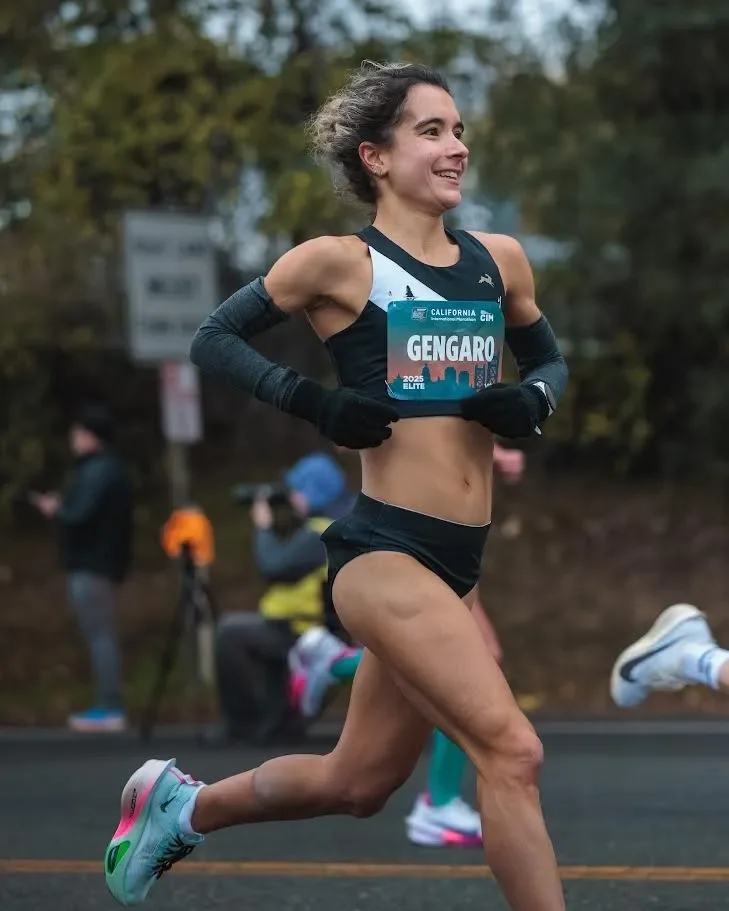
Izzi Gengaro (MIT 2023), a Ph.D. candidate at Stanford, had her sights pinned on an OTQ her entire build. She sensed that as her experience and workload capacity steadily grew, so would her chances. “My goal going in was to OTQ. Although it would be an almost 3-minute PR to run sub-2:37, my training indicated that it was within the realm of possibility.
The vibes of the entire race were incredible. The opportunity to toe the line with 8 teammates was phenomenal— 7 of us achieved OTQs which only amplified the emotions of the day. Crossing the finish line and ending up in the arms of my teammates who already finished is a feeling I can’t do justice with words and was only paralleled by turning around to watch another teammate squeak under 2:37. When I crossed the line and knew that I hit the time, (I) was hit by a wave of gratitude. Later, when the raw emotions settled, I was able to attribute that overwhelming gratitude to Dena, my incredible teammates, my family and boyfriend, and my health. I would also be remiss not to mention my college coach, Riley Macon, who allowed me to believe that the injury cycle I experienced in college could end.”
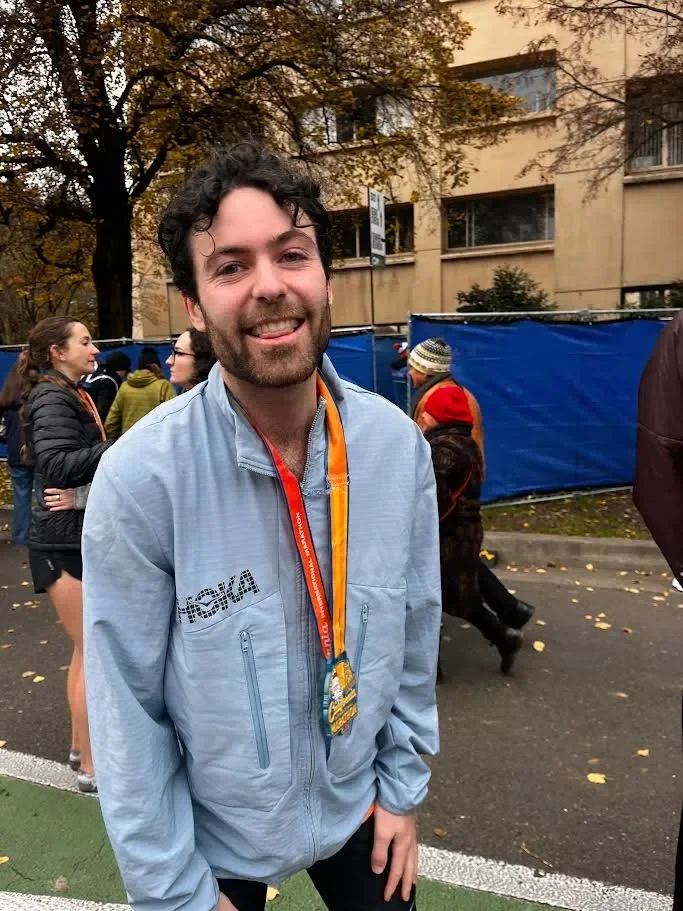
Henry Pick (CMS 2023), meanwhile, had no ironed-out goals at all. The software engineer living in Seattle felt “(an) OTQ was a dream goal - definitely not one that I was going to be frustrated about if I didn’t hit it. I was really just looking to PR (ran 2:20:40 for my first marathon back in February). I focused more than I have in the past on not overburdening my body. Just putting in two serious workouts a week and trying to keep a positive balance of energy between running and my job has seemed to serve me quite well. I used to be far more hardcore in college and even up until earlier this year when I ran my first marathon—I remember the time I did a 21 mile long run in the SoCal heat without water or the week that I put in 80 miles and also fought through Covid. I realize now that those sorts of things did not make me a better runner physiologically nor did they make me grittier. They were just sort of dumb. While I do think there is no replacement for a hard workout, shifting the priority from intensity to consistency has provided me with a new platform for growth as a runner and also just a person in life.
The first five miles felt slightly scary. I purposely did not wear a watch because I knew that OTQ pace was faster than what I had trained for. The pacing and weather were amazing though and I kept envisioning the image of that breaking 2 project they ran with the wind-breaking pacers, but in this case 16 minutes slower. I think my only major mistake in this race was not properly fueling in the last 7 miles, where it actually becomes the most critical to fuel correctly. The last 3 or 4 miles were just holding on to positive thoughts. My friend Adam Wilkinson was a particularly strong proponent of me shooting for this goal and I think his words of encouragement really hit home in that moment.”
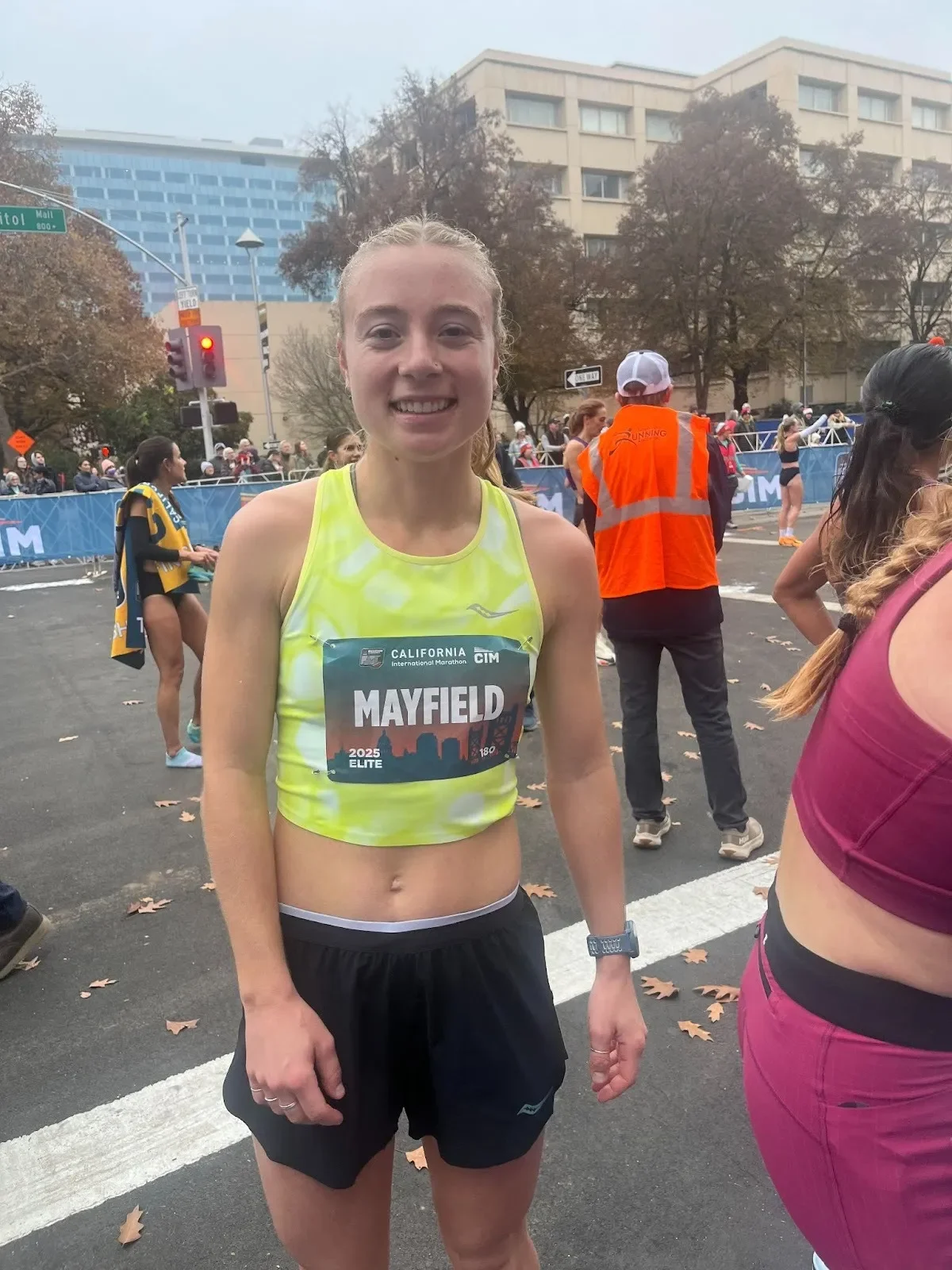
Clara Mayfield (Carleton 2023) recently moved back to her home state and started medical school this fall at the University of Kansas. She ran a 19-minute PR. (2:53 at Grandma’s 2025 in June -> 2:34 at CIM). “I’m not super surprised, but things did line up well - I’ve found a running community here (Kansas City KS), I’m coached by pro runner Reid Buchanan who lives here too, and I’ve found a surprising amount of post-collegiates - I’m almost never alone on long run days. My build wasn’t perfect by any means. It’s been challenging with starting medical school and adjusting to post-collegiate running. Med school is hard - but Carleton was really hard - so I’m challenged but it’s something I’m used to. And it was the best day for it. Towards the end of the race I thought, ‘Wow, I’m going to run so fast, I don’t even need to speed up!’
Finishing the race I felt proud of myself, a little relieved, and very grateful. Marathon training has been different in that I haven’t had a full season of races to test my fitness and have chances to run fast - it felt like my whole training block was going into this race, which comes with some pressure. I was relieved to finally cross the line and have that go away. I felt super grateful for all the support I’ve had throughout the season. Reid helped so much in my quick transition to the marathon post college. My mom, aunt, and cousin were there at the end of the race. And when I got my phone back, I had over a hundred messages from more family, past teammates and coaches, friends, and my med school small group. It was a big goal to go for an OTQ in my first semester of med school and it was far from easy, but this race really was a perfect end to it all.”
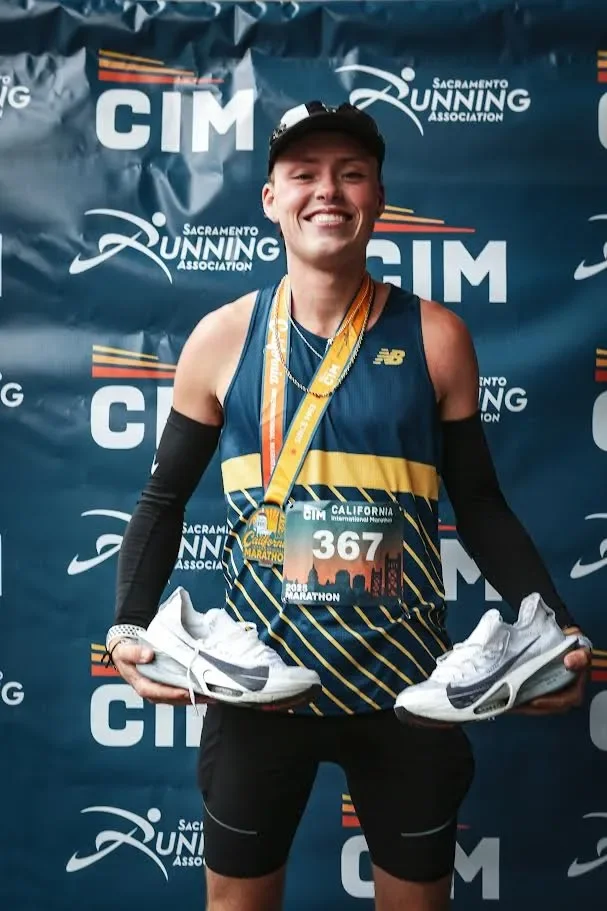
Lars Dewall (St. Scholastica 2024) on the other hand moved somewhere entirely new, uprooting his life from the cold shores of Duluth, Minnesota 2,500 miles to San Diego, where he teaches middle school social studies, studies for an M.S. in sports management, and bangs out 110-mile weeks. “I had full intentions of putting myself in the OTQ pack. I was confident in myself and the training I had done following my debut at Grandma’s that this was a realistic goal that I could achieve. Following Grandma’s I was able to recover well and start a huge training block right around the beginning of August. This began shortly after moving to San Diego in late July. During this block I put around 14-16 weeks ranging from 100-125 miles. A normal day would look something like a wake up around 5:30am, a 5-6 mile AM run, teaching from 7:30-3, and a workout or longer run in the afternoon. These would usually range from 10-14 miles. Sundays were always reserved for a longer run (about 18-20 miles). Although it was a tough schedule I was able to take really good care of my body during this time, manage workout and running load well while staying happy & healthy!
The race vibes were exactly what marathon dreams are made of. A fast course on a chilly morning with no wind, feeling like an all-too-normal Minnesota fall day. Race morning did feel a little chilly having been in San Diego the last 6 months, however, it proved to be perfect conditions for fast running with the OTQ pack. I came through the half tucked into the middle of the pack at exactly what I had hoped for (1:07:30). After this I continued to feel good, fuel well and made a choice at ~16 miles to just start racing. I broke away with a string of individuals somewhere around this point and was able to close the second half in 1:06:47. Things started to get tough about mile 20 but I kept trusting in myself and my training. I kept reminding myself that I had put in way too much training and sacrifice to not give this race every last drip of effort I had. I was able to finish the race strong placing 23rd with a closing 50:55 last 10 miles. Having the support of my team, friends and family all tucked into the back of my head during this time gave me everything I needed to finish CIM 2025 strong.”
—-------
What to make of these performances? Mostly, that a big goal like this is possible for them, and it’s possible for you. Role models are all around us. Life spins in new and unexpected directions and you can still match the inertia with your legs if that’s what you desire. Spirit is what’s needed, and everyone above demonstrably possesses that trait.
I am chasing an OTQ myself. Having recently moved to a freezing altitude town at 7,000 feet with no training partners, it can feel daunting if I think too hard about it. And yet, every mile after work, in the darkness and the howling wind, I look up at the constellations and I feel a reassurance that the stars don’t present themselves differently to anyone else. Providence to personal circumstance, thankfully, gets lost in the December breeze. The right move is the one we commit wholeheartedly to - and the beauty of marathon training (and running as a whole) is that the required traits to succeed at it are transferable to every more legitimate aspect of adulthood in this day and age.
It’s always been a game of numbers. But it’s also an act of perpetual intentionality, and leaning into one’s community, and a steadfast love of the game as always. I’m inspired by the people here who have achieved an OTQ this early. They have their own battles now - a lot can happen 2.5 years from now to the trials.
The rest of us have 2 years left to achieve this goal.
—------
Thank you to all who have been reading along this fall. The marathon series will return in the spring, featuring many more of you!