Mo Bati stripped of NCAA eligibility

A big thanks to Bombas for their support this fall. You train hard. Your socks should work just as hard. Trust us they make all the difference. Use code GloryDays21 for 21% when you checkout on Bombas.com
On the evening of December 24 when many throughout the nation were observing Christmas holiday traditions, Mo Bati was grieving the loss of a season. In conjunction with one of his textbook ten-mile runs along the Mississippi River in Minneapolis, Bati posted the following statement on Strava:
“I don’t think some NCAA rules are fair to everyone. I want to share something real today.
Last semester I was struggling a lot with money. I didn’t want to drop out or stop going to school, and the community around me came together to support me. People helped me with around $6000 so I could pay for that semester. I’m still grateful for that it was love, it was support, not anything big or business or something bad. Just people helping someone who needed it.
But the NCAA saw that support and said it was a violation. Because of that, I can’t run indoor or outdoor this year. They said someone paying for my school breaks the rule. I understand that’s their rule, but I don’t think they look at the story behind it. Sometimes people get help because life is hard. Not everyone has money. Sometimes it’s just one moment, one time, trying to survive and move forward.
It feels sad that instead of seeing support as community love, it’s seen as something wrong. I didn’t get paid. I didn’t get something crazy. Just help to stay in school. And because of that, I’m not allowed to run. That part is not easy to accept. I worked hard. I love running. I wanted to run this season with my teammates, make memories in my last year.
But even with all this, I’m still grateful. I’m thankful for everyone who helped me, who believed in me. I’ve been through a lot in life, and this is just another challenge. It will not break me. I’m not disappearing, I’m still here, still training, still smiling, still fighting for my dreams.
Sometimes rules don’t see the human behind the story. But I hope one day, things like helping someone won’t be a reason to stop them from doing what they love.
Thank you to my community, thank you to everyone who supports me. I will keep going.”
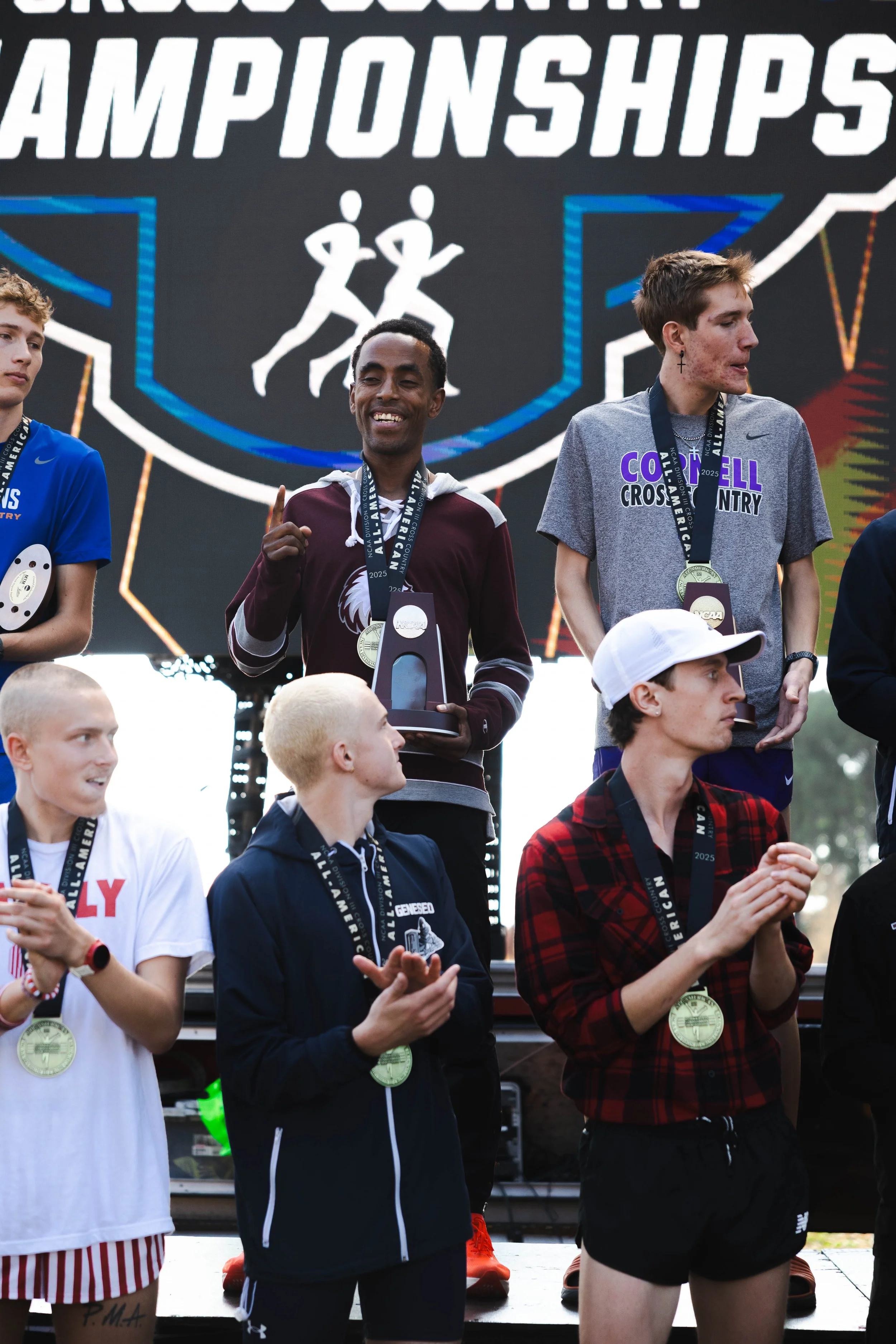
Photo by Jen Reagan
Bati, a night-shift nursing aide in an assisted care facility and full-time student-athlete at Augsburg University, has been suspended for his final indoor and outdoor track seasons for accepting community donations to help him stay in school during a time of financial hardship.
D3 Glory Days reached out to Bati, the NCAA, and Augsburg University for comment on the suspension. Through these conversations and additional research, we learned how context complicates the application of seemingly straightforward rules.
The Rules
NCAA Director of Communications Michelle Brutlag Hosick explained what happens in instances of NCAA eligibility violations.
“When a school discovers rules violations that impact a student-athlete’s eligibility, the school declares the student ineligible and, if appropriate, seeks reinstatement of the student-athlete from the NCAA national office staff,” Hosick said. “The staff reviews the information submitted along with previous decisions in similar cases and issues an initial decision. That decision can be appealed to a committee comprised of representatives from other Division III schools.”
It appears that Bati’s violations come from Article 15, the section on financial aid in the NCAA rules manual. Bylaws 15.01.1 and 15.01.3 lay the groundwork for financial aid in D3, stating that student athletes may receive financial aid from member institutions so long as it does not conflict with the governing legislation of D3. Specifically, that aid may not be awarded on the basis of athletics leadership, ability, participation, or performance (aka “pay to play”).
Bylaw 15.01.6 Contributions by Donor further clarifies impermissible aid, stating: “it is not permissible for a donor to contribute funds to provide financial aid for student-athletes.”
In Bati’s case, accepting a $6,000 donation from the community directly violated bylaw 15.01.6, the spirit of which also violated 15.01.3 Criteria for Financial Aid.
The consequence of receiving a donation, something considered “improper financial aid” is defined in bylaw 15.01.2, which states:
“Any student-athlete who receives financial aid other than that permitted by Division III shall not be eligible for intercollegiate athletics.”
News about the suspension of the two-time NCAA D3 cross country national runner-up soon swept the running community and even mainstream media, like the New York Post, with runners and non-runners alike posting to social media in support of Bati.
Though initially wanting to keep the news under the radar, Bati agreed to share his story with D3GD via the podcast. He explained that through everything, he wants governing bodies to see the humanity behind their rulings.
“NCAA is a big system,” Bati said. “They have to understand people…understand people’s struggle. It’s not about money. It’s not about only Mo Bati. Behind that system, someone is standing there. Someone who can think, someone who can feel, someone who can go through something. So we have to understand each other. That’s why I’m trying to put some caption… People have to see the truth, if that’s right or wrong.”
Bati explained that he learned about the violation about a week before his Strava post and wrestled over whether or not to speak up. Ultimately, he wanted the people who support him to hear his story.
“I was thinking like, ‘Okay, can I tell this to my people?’” Bati said. “The support I got from D3, the support I see, like the love I got. Seeing these things and ‘I have to share to them.’ And then I debated with myself, ‘can I do it?’ ‘Okay, why you wanna do it?’ ‘Okay, this is not fair, you know?’ And then, ‘I have to do it.’”
NIL & The Rising Cost of College Tuition
Rules about receiving donations are in place to prevent a “pay-to-play” model, something strictly forbidden and unique in D3, but with name, image, and likeness (NIL) deals changing amateurism in college sports and the cost of college tuition sharply increasing, one has to wonder if D3 athletes are getting the short end of the bargain.
In brief, NIL allows athletes to be financially compensated for the use of their personal brand, something that, prior to 2021, athletes signed away their rights to while the NCAA, its member institutions, and even some coaches could profit off of them. The larger House vs. NCAA settlement ruled that $2.8 billion dollars in payouts would be issued to former D1 student-athletes who competed between 2016 and present day. D3 is not listed as included in these payouts (this 2018 D3 grad, 2017 top collegiate finisher at USATF outdoor nationals, and 8-years professional athlete is not salty or anything).
On top of payouts, current NCAA D1 athletes are afforded multiple ways to receive income, like revenue sharing where schools can directly pay the athlete, commercial NIL from third-party compensation for product endorsements, and NIL collectives that gather funds to pay athletes for marketing activities.
NIL-NCAA estimates that NCAA D1 athletes will receive over $2.3 billion in NIL and revenue sharing, with the average D1 athlete at a power conference school earning over $35k per year (these stats heavily skew toward men’s football and basketball players). In addition, Opendorse predicted athletes would earn a total $1.95 billion on commercial, collective, and collegiate NIL income. On3, an index that lists athlete projected annual values, reports that the highest valuation in the NCAA belongs to Texas quarterback Arch Manning at $5.3 million.
Though current D3 athletes can now make money through NIL, the stats on how much they actually make are practically non-existent, with general NIL advice urging D3 athletes to focus on building social media followings and sponsorships from local brands and within the community in the absence of the revenue sharing opportunities awarded in D1. So why does Bati’s community donation not fall under NIL?
Under the new NCAA NIL rules, donations for tuition costs are still not permitted at any division. This NCAA Q&A states that “NIL agreement without quid pro quo (e.g., compensation for work not performed) [is prohibited]. Student-athlete NIL agreements should include the expected NIL deliverables by a student-athlete in exchange for the agreed upon compensation and student-athletes must be compensated only for work actually performed.”
Thus, there appear to be some loopholes that could allow a student-athlete to accept money from individuals in the community in exchange for certain NIL “deliverables,” such as doing a commercial, signing autographs, or participating in a photo shoot, according to Informed Athlete. It is possible that if Bati’s fundraiser were set up to exchange signed autographs with donors, it could have been a legal NIL exchange (likely with more strings attached, like reporting the deal to the College Sports Commission).
All this to say, not only is NIL limited in its scope for D3 athletes but it’s also incredibly complicated for student-athletes to navigate on their own. Augsburg’s athletic site lists an NCAA compliance officer, who would likely field all NIL questions, as well as a compliance tab on their website, but does not appear to have any information online about NIL for student-athletes. Though plenty of D3 athletes contribute to promoting their institutions through their name, image, and/or likeness, they are not compensated anywhere near how a D1 athlete is.

Photo by Jen Reagan
Bati became Augsburg’s men’s cross country program’s first All-American in history with his 2024 runner-up finish, the highest finish in combined program history, and then became the first multi-time cross country All-American in combined program history in 2025. Athletic performances like Bati’s are the kind that draw attention to universities, boost recruiting prospects, and generate revenue for the university, yet the senior nursing student and standout athlete was struggling to pay for his own tuition.
The cost of college tuition has more than doubled in the past 20 years, making college education an increasingly more difficult financial option for prospective and current students. In 2025, the average annual cost to attend a private institution was $51,316 according to data from U.S. News Best Colleges 2026. Augsburg reports a 2025-26 tuition of $45,992 (excluding room and board, which can range from $2500 to $10,413 per year depending on living circumstances). This cost is up over $4,000 from the 2022-23 year when Bati started as a student there (the cost was $41,284 per year in 2022-23).
Augsburg declined to comment directly, but issued a formal statement on Bati’s suspension, making it clear they are following all compliance and also showing some support for Bati by acknowledging his financial hardship:
“Augsburg University has followed all NCAA rules to the best of our knowledge and has acted with transparency throughout this process. Augsburg understands the intent of the NCAA guidelines for Division III student-athletes that restrict financial support to family sources and non-athletic scholarships. At the same time, we also recognize that these rules may unintentionally create barriers for low-income or first-generation student-athletes, limiting opportunity and access to higher education and intercollegiate athletics not because of performance, but because of financial circumstances.
We would welcome consideration from the NCAA about potential adjustments to the financial aid rules to allow greater flexibility around aid sources when a student-athlete can demonstrate financial need.”
Bati agrees that he hopes his case will serve as an example for future decisions to consider context in their rulings. “This is a fix for someone in the future,” he said. “Think about if this system says they’ll help Bati. If they didn’t help me today, someday, someone comes with the same situation, that means this community did not help me [or] that person because of this system. But if they fix it because of this, for someone, life is bright in the future. They go to the highest level. It’s not about me. When something [is fixed], it’s helpful for everyone.”
According to a source familiar with the matter, the school has not submitted a reinstatement request as of Dec. 28. The same source said that similar cases to Bati’s have been reinstated in the past. Augsburg did not comment on if they planned to seek reinstatement for Bati. With the majority of NCAA schools on semester break and the indoor track season picking up in two more weeks, the school would feasibly still have time to submit a request to reinstate Bati’s indoor eligibility should they choose to.
But for now, Bati is focused on finishing his senior year and earning his nursing degree. He will remain at Augsburg for his education whether or not he gets to compete. “I’m always excited because I have a dream. I have ambition to fight for every day. I just want to do the same thing I’m doing before, just live life, and then move on with my life and just do the right things.”
Looking Ahead
Just over a month ago, Bati was storming down the final straightaway of his NCAA cross country career in Spartanburg, South Carolina, neck and neck with eventual national champion Emmanuel Leblond. After an untimely fall around 400m into the 2025 NCAA D3 National Cross Country Championship men’s 8k race, Bati found himself in 137th place instead of in the front pack with the leaders. He managed to stay calm and collected, and his perseverance landed him the national runner-up.
Weeks later, he placed 11th in the California International Marathon (CIM) in an Olympic Trials qualifying time of 2:12:27. The future is bright for the D3 distance star, and in a moment that perhaps foreshadowed another hardship to come, one he is currently living through with the stripping of his NCAA eligibility, Bati did the most important thing he could have done: he got back up.
“One thing is I want [people to] know the truth,” Bati said. “Second, this is just part of your journey, you have to go through something, [nobody’s] perfect, nothing [goes] perfect for your life. You have to feel something simultaneously. The third is just move on, that’s it, simple. Live your life, fight for whatever you desire for.”