Making magic: The mindset shift that propelled Claire Anderson to the national level
A big thanks to Bombas for their support this fall. You train hard. Your socks should work just as hard. Trust us they make all the difference. Use code GloryDays21 for 21% when you checkout on Bombas.com
It’s a late May, Ohio night. There’s a chill in the air as Baldwin Wallace’s George Finnie Stadium shines alone in the darkness of night like an otherworldly object. Fog hangs in the air; the steam from the mouths of athletes working up a sweat beneath warm layers. The scent of Tiger Balm burns in corners of the stands, where athletes huddle together with blankets and kettle corn. Sweats swish back and forth on the infield. It’s an atmosphere making even the most tenured athletes shiver.
Known for producing fast 1500m times every outdoor season, Harrison Dillard Twilight sees athletes across multiple divisions, and often serves as a last ditch effort for Division 3 athletes to clinch national qualifying times. The hot heat of the 2023 women’s 1500m boasts two unattached runners, Division 2 standouts from Hillsdale, and two-time All-American Baldwin Wallace’s Hope Murphy - looking to defend home turf. Another face on the start line belongs to a wide-eyed Washington & Jefferson freshman.
Claire Anderson feels magic in the air as she toes the line. The gun fires and runners explode from the line. Despite her relative youthfulness in the sport, Anderson navigates the field swiftly. She is sure-footed and moving as if propelled by something supernatural. Entering the race with a personal best of 4:36, even Anderson didn’t expect what the clock would read as she slingshotted out of the final turn. 4:25 as the winner crosses. 4:26. 4:27. Others, including Murphy lean for whatever milliseconds they can grasp. 4:28…
“No way,” Anderson thinks to herself. She is going to nationals.
…
“4:29!” Derek Workman, then W&J Head Cross Country Coach, exclaimed. His voice crackled through the phone, but sounded familiar enough to then West Liberty Head Cross Country Coach, Justin Simpson. Simpson could feel Workman’s excitement through the airwaves.
Running was funny like that - always connecting people. Simpson’s connections ran all the way back to his high school Footlocker National days, when he knew he’d find a way to stay in the sport long-term. Work respected work. Talent eyed talent. While Simpson didn’t Coach Anderson, he and Workman had built enough rapport over their coinciding meet schedules for him to feel a bit invested in her performances…especially when they turned heads as much as this one.
4:29? He thought to himself.
How is that even possible?
Simpson knew Claire’s talent - or thought he did. He saw it frequently at meets throughout the season, but nothing like this. Nothing foreshadowing national greatness.
Simpson hung up the phone.
There’s something there.
…
“I feel like there’s a point that you hit where every run just feels incredible. And I was at that point where I was just on a high,” Anderson said of her 2023 Twilight effort.
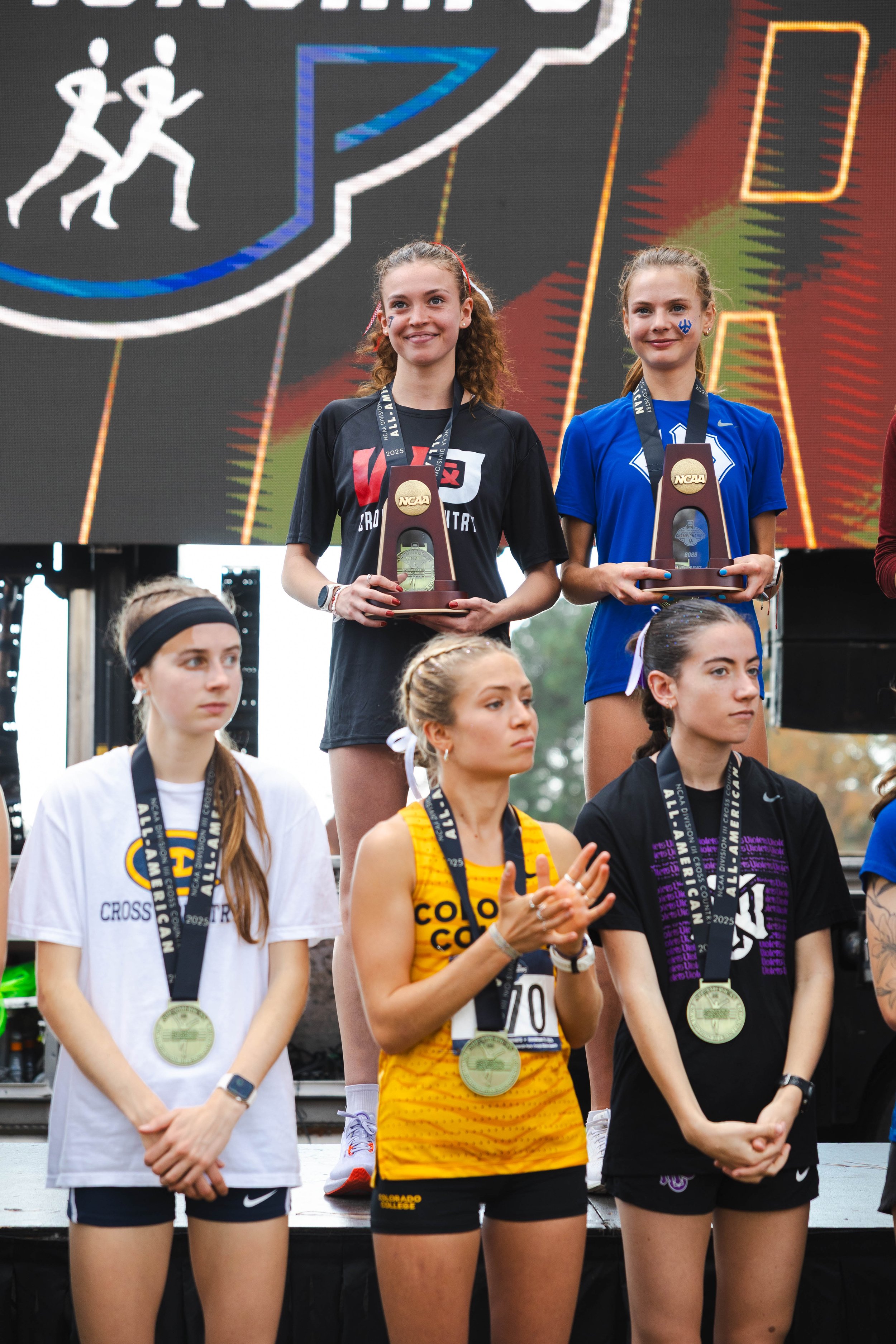
Photo by Jen Reagan
Now a senior, Anderson has proceeded to make a name for herself on the national level. With five national championship appearances, two All-American honors, and a recent personal best of 16:48 over 5,000 meters, Anderson has begun actualizing the potential Simpson saw for her on that early summer night in 2023.
Beginning her collegiate career under Workman, Anderson experienced the mentorship of three coaches total, as Workman went on to pursue an opportunity at Roanoke College, and W&J alumni, Paul Collier, acted as interim for a year, and, finally, none other than Simpson took the helm.
Anderson and Simpson would both agree that Claire’s big break came from that 2023 Harrison Dillard Twilight meet.
“I felt like it was going to be a good day,” Anderson said. “Like, I felt that magic.”
Recreating that “magic” proved a struggle for Anderson, though she always knew it was there. While training remained steady up until the national meet that season, Anderson rode an emotional rollercoaster, feeling the pressure to outdo herself once more.
“I don’t remember a lot from that outdoor meet because I was so high strung and so stressed out,” Anderson said. “Like I really was not mentally there.”
Intermittent achilles tendonitis, coaching changes, and illness stalled Anderson’s development. As a runner thriving on momentum, chasing the aforementioned “high”, Anderson not only learned the value of consistency in training, but also her emotions - regardless of what life and running threw at her.
“I realized I was an emotional runner,” Anderson said, “and there were a lot of times where that sort of seemed to mess me up and I would blow up.”
Upon taking over the Presidents’ program, Simpson made minor tweaks around training and racing, like cherrypicking important races to target for personal bests or team points. As an athlete prone to illness and battling semi-chronic achilles tendonitis, Anderson thrived on this new competition style.
“I felt like Claire was racing too much and I like to focus on training for very specific races, looking at a very long term approach,” Simpson said. “Not every meet is the Olympics.”
Simpson’s approach of “training through” races, slowing things down, and keeping his team’s sights set on bigger and better events wasn’t the biggest “game changer” at W&J. While one of the first to grasp Anderson’s potential and strengths, he also recognized her inconsistencies, and viewed them as an opportunity for growth.
“Claire was riding very high highs and extremely low lows on a week-to-week basis when I first met her,” Simpson said. “It’s just not consistent, where you want to be. Not just in running, but as a person.”
Simpson’s most pivotal coaching moments with Anderson happened off the track. As Anderson aimed for more attainable, consistent workouts and mileage, Simpson had regular meetings with her to ensure her emotions mirrored this consistency.
“That was the biggest thing I needed to change last year - it wasn’t a training thing or workouts and stuff at first, but it was keeping her more relaxed and calm,” Simpson said.
Over the course of one year, Anderson and Simpson saw positive changes. As Simpson worked with Claire to improve her stress management skills, Anderson’s workouts found a smoother trajectory upwards. Moreover, small training hiccups and bouts of illness didn’t become catastrophes anymore, as Anderson found herself able to roll with the punches better than ever.
“I saw changes all last year, but it was always changes in the right direction,” Simpson said. “And sometimes we’d have setbacks, but then we’d get back on track.”
Simpson’s stress-management practices didn’t only yield steady improvements in Anderson’s performances, but multiple athletes on the team. Understanding that stress utilizes energy, Simpson worked to eliminate race-day stressors in his athletes by occupying them with other “tasks.” At the 2024 SUNY Geneseo Mike Woods Invitational, Simpson told his athletes to give him a thumbs up whenever they saw him in the race. Anderson, and many others, ran what were PRs at the time.
“They were all coming to me dumbfounded that being relaxed can get the best result out of you,” Simpson said.
Moreover, Simpson preaches the spirit of competition over the importance of times in his athletes, as times often yield added stress.
“It is really about letting the fitness you’ve gained take hold and not forcing a race,” Simpson said.
Simpson’s experiences as a multi-time state champion, collegiate athlete at Northern Arizona University and West Virginia University, and Boston Marathon qualifier showed him that a crucial element in running could make or break an athlete’s long-term performance: the clock. Simpson discovered he ran his best races in fields where time was of no concern, and found consistency in training when he didn’t let paces or a clock dictate his emotions. As a coach, it irks him when others talk about times and paces, something he strives to avoid. Anderson’s experience that night on the Baldwin Wallace track seems to back his claim.
“Most people’s PRs are when they were in a very highly competitive field, and they race the field well, and then they look at the clock and it said something they didn’t think was possible,” Simpson said.
Anderson appeared in peak form leading up to the 2025 NCAA D3 Cross Country Championships, and her consistent training left her and Simpson hopeful for an improvement on her 23rd place finish from 2024. An expert in the nuances of the sport, Simpson understood the difference between 10 places could be as small as four seconds. Simply put, those once-in-a-blue-moon magic races come down to more than just fitness, as energy management (particularly by way of stress) and a little bit of luck can all factor into those vital seconds. It’s when these elements all converge that the real magic happens.
…
Anderson stares off into the morning mist blanketing the Roger Milliken Center cross country course. Her final strides are done. The work is done. A sense of calm rushes over her - moments before the storm. A single tear falls from her eye.
I am where my feet are.
The gun fires and chaos ensues. A mess of limbs starts scrambling to move forward through space, clutching and punching at the air ahead of them. But Anderson is not lost in it.
I am here.
I am able to do this right now.
I am able to push my body to its limit.
Anderson relinquishes her body to the rhythm it’s grown accustomed to over months of training. It is ready for this moment - covering the final six kilometers of her collegiate cross country career. To Anderson, this moment has become a gift.
The kilometers pass and Anderson remains near the front. A few runners have gotten away off the front, stringing out the field. But a lot can happen over six kilometers.
…
Simpson watches her pass four kilometers in eighth place. Anderson is surrounded by the colors of NYU, Calvin, and Chicago. It’s anyone’s game.
This is a good day, Simpson thinks.
Anywhere from 4th to 10th place.
He takes off for the finish, excited to meet her there, as she seemed to have a lock on improving her finish from last year.
…
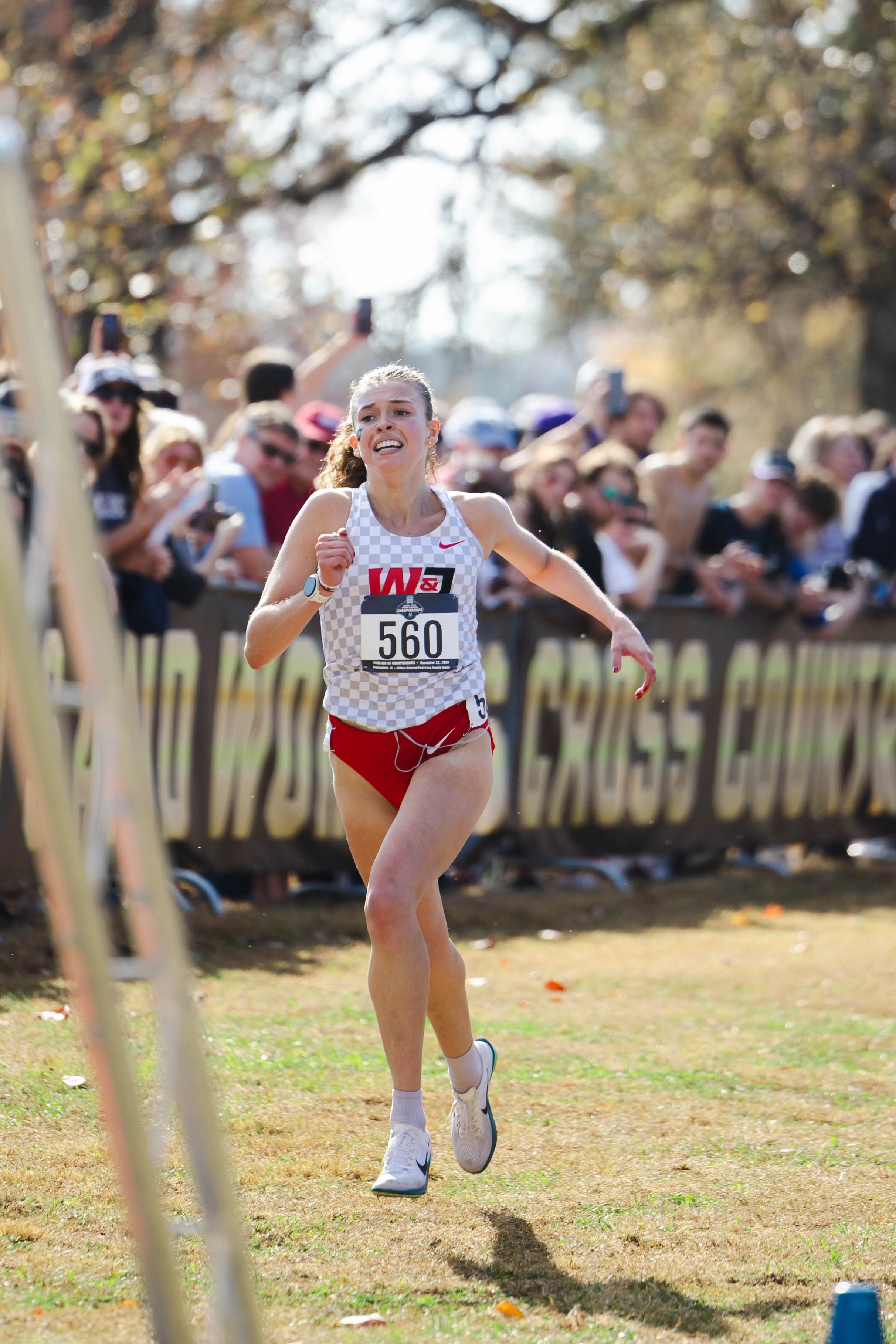
Photo by Jen Reagan
“I had no idea I passed that many people, that’s how super-focused I was,” Anderson said.
It took a friend telling Anderson that she placed third for her to realize what she’d just accomplished. Rather than thinking about the place or time, Anderson found herself thinking about how grateful she was for this race. As she closed on the line, her emotions came back to her.
“I was really like, ‘I love this sport. I love doing this. This felt like a good race. What a beautiful way to end,’” Anderson said. “It’s really like Coach Simpson said, when you forget about the time and place, it will follow.”
Anderson and Simpson hope to carry this consistency into track season, where they plan on targeting the 3k and 5k distances. Anderson recently broke the 17 minute barrier in the 5k running 16:48.20 at the GVSU Holiday Open. Simpson anticipates this early season race qualifying her for the national meet, which will allow them to be a bit more patient with training moving forward.
In the meantime, easing into things, Anderson aims to stay consistent, letting the magic happen when Coach Simpson says it should.